


Financial stress is the persistent anxiety that comes from feeling your money situation is out of your control, and it behaves differently from most other worries. A deadline passes and the pressure lifts, or an argument gets resolved and the knot in your chest unwinds. Money worry, by contrast, renews itself every morning, because rent is always coming and the fridge always needs filling. Understanding why it weighs on the mind so heavily is the first step toward carrying it differently, and there are proven ways to do exactly that.

TL;DR
- Money worry hijacks attention in a way researchers call the scarcity mindset. It is a normal brain response rather than a personal failing.
- The body treats an unpaid bill like a physical threat, which is why financial stress shows up as poor sleep, irritability, and tension.
- Shame thrives in silence. Naming the worry, to yourself or someone safe, loosens it.
- Pairing emotional coping with one small practical step works better than either alone.
Why does financial stress feel different from other stress?
Psychologists who study scarcity have found that not having enough of something essential changes how the mind works. In their research on the scarcity mindset, Sendhil Mullainathan and Eldar Shafir showed that financial pressure consumes cognitive bandwidth, the mental capacity we use for planning, patience, and self-control. When a large part of your mind is quietly running the numbers on rent, there is simply less of you available for everything else.
This is worth sitting with, because it dissolves a common source of shame. Forgetting appointments, snapping at your kids, or making an impulsive purchase during a broke month does not mean you are careless. It means your mind is doing what minds do under scarcity. Year after year, surveys such as FP Canada’s Financial Stress Index find that money outranks health, work, and relationships as the leading source of stress in Canadians’ lives, so if this is you, you are in very large company.
What does money worry do to your body?
The stress response evolved for short emergencies, and a bill you cannot pay every month is not a short emergency. The body reads financial threat the way it reads physical threat: cortisol rises, sleep gets shallow, the jaw clenches, and appetite swings. Over months, that background hum of alarm wears people down, which is why financial strain so often travels together with low mood and anxiety. The Canadian Mental Health Association notes that stress left unaddressed becomes a risk factor for both.
None of this means that anything in you is broken. It means your alarm system is working, just aimed at a threat that push-ups and adrenaline cannot solve. The task is to give the alarm what it actually needs, which is evidence that the situation is being handled.
How do you quiet a mind that keeps counting money at 3 a.m.?
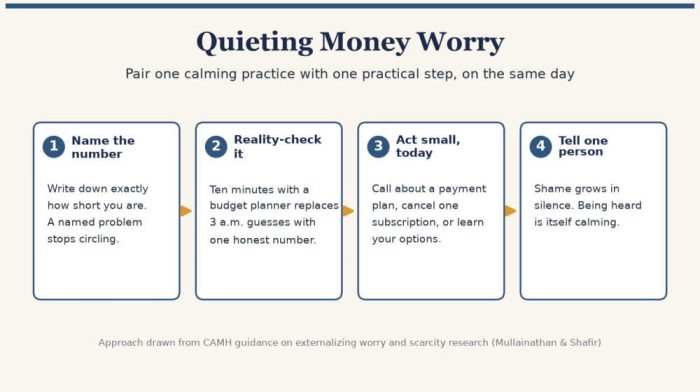
Start by naming the worry out loud or on paper. Vague dread is heavier than specific problems, and the act of writing “I am short about $400 this month” converts a fog into a fact. Facts can be worked with. Clinicians at the Centre for Addiction and Mental Health recommend exactly this kind of externalizing for anxious rumination, because a worry on paper stops circling in the head.
I’ve often found that journaling helps me to process my stress, anxiety and worry. If you don’t journal, try just jotting down some notes each evening or when the worry grips you most. Write down what you are worried about or what happened during the day or what you fear. Having it on paper can make it seem less scary, less unknown. It can also help you move on to the next step.
Give your anxious mind one honest number to hold. Ten quiet minutes with the free budget planner from the Financial Consumer Agency of Canada tells you the real size of the gap, which is almost always more manageable than the 3 a.m. version. The brain treats uncertainty as danger, and precision, even unpleasant precision, calms it.
Unknowns often feel big and scary. Budgeting and tracking money never seems like a fun activity, but at times when I didn’t do so, then my financial worries grew because I didn’t know what money was coming it and how it was going out—I just knew that those two numbers didn’t match up. When I was able to create a budget and to see my expenses and income, then I was able to make a plan.
Finally, tell one person you genuinely trust. Money is one of the last taboos, and the silence around it is where shame grows. A partner, a trusted friend, or a counselor does not need to fix anything. Being witnessed is itself regulating, and it often surfaces options you could not see alone. It can help just to say, “I’m really worried about money this month” and to have a friend say, “I know what that’s like. It’s really hard.”
What practical steps actually reduce the stress?
Emotional coping settles the nervous system, and practical movement convinces it to stay settled. The most effective approach to managing financial stress pairs the two: one calming practice and one concrete action, however small, on the same day.
For example, call the utility company and ask them about a payment plan or possible discounts on your bill. Pick one subscription you could cancel this week. Learn what regulated short-term credit from a licensed Canadian lender actually costs, so that if you ever consider it for a genuine bridge, you decide with clear eyes instead of panicked ones at midnight.
Small actions matter more than their dollar value suggests, because each one is evidence against helplessness. Helplessness, more than the shortfall itself, is what makes financial stress corrosive. People tend to cope far better with a hard situation they are actively working than a merely uncomfortable one they feel trapped inside.
When is it time to reach for more support?
If money worry has started to crowd out sleep most nights, strain your closest relationships, or pull you toward numbing habits, that is the moment to widen the circle. Community agencies offer free credit counseling, and talking to a mental health professional about financial anxiety is as legitimate as seeing one for grief or panic. You do not need to reach a crisis to deserve help.
Watch, too, for the quiet signs of improvement: opening bills the day they arrive, checking your balance without the stomach drop, making one money decision without rehearsing it for a week. Recovery from financial stress rarely announces itself, and noticing these small returns of ease is part of the healing.
Frequently Asked Questions
Is financial stress a mental health issue?
Persistent financial stress is a recognized risk factor for anxiety and low mood, and it deserves the same care as any other significant stressor. Support can come from both financial tools and mental health professionals, and the combination works best.
Why do I make worse decisions when I am broke?
Scarcity research shows that financial pressure consumes the mental bandwidth used for planning and self-control. It is a predictable effect of the situation, not a flaw in your character, and it eases as the pressure does.
What is the single best first step when money worry takes over?
Turn the vague dread into one specific number by writing down exactly how short you are. A named, measured problem engages the planning mind, while an unnamed one only feeds the alarm.
No Responses Yet