


One thing I’ve learned as a mom is that, whatever stage of motherhood you’re going through, it makes a huge difference to know other moms who share your experience. Motherhood (particularly in today’s world) can be a very isolating experience, for a variety of reasons, but when you find another mom who can understand your unique journey, it makes that journey so much easier. While I don’t have any experience with raising a son with epilepsy as Jen Murphy Parker does, I do know what it’s like to have a high-needs child who demands more than I feel like I can give.
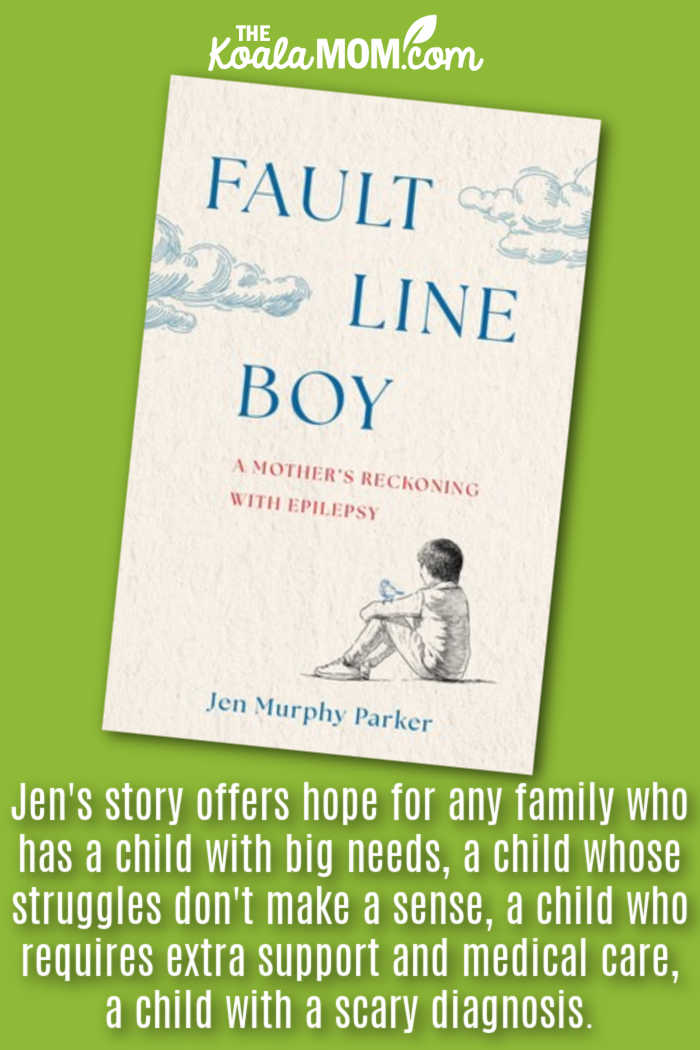
Jen’s memoir Fault Line Boy: a mother’s reckoning with epilepsy is written more as a series of essays than chapters. In her afterword, she notes, “This book is myopic, intentionally so. Everything beyond raising a child with health risks and disabilities tends to bur in the recounting. But that’s just the retelling of it; it’s not how it was.” This memoir captures the feelings, the gut-wrenching emotions of what she went through, more than concrete details or timelines. I read Fault Line Boy in a short time, wanting to find out what happened, but also had to put it down a few times because the story was so difficult to hear.
I received this book for review courtesy of the publisher; all opinions expressed remain my own. This post contains affiliate links; as an Amazon associate, I earn from qualifying purchases.
Fault Line Boy overview
Jen begins with Lew’s babyhood and the first big scares of fever and seizure that resulted in 911 calls and hospital trips. She recounts her pre-motherhood dreams of building her family, stories of mishaps with her other babies (including one nearly getting swapped in the hospital), and her decision to have a fourth baby. She describes Lew as a happy, easygoing fourth baby, until…
Jen is honest about the hardship of Lew’s first seven years, of never knowing when a seizure might hit him, of the precautions they had to take, the doctors they saw, the hospital visits and questions and desperate attempts to find something to help him. She talks about helpful doctors and unhelpful doctors, about the devastation of the tests that revealed Lew would never live a “normal” life. In one chapter, she discusses the way we as parents project a life for our children and what the “other Lew” might have been like, without this genetic anomaly.
Just when the story feels too heavy, when Lew’s situation feels overwhelming even for a reader, the story turns. Jen introduces us to teenage Lew, to the miracle of a trial drug that ended his seizures. Without his brain going haywire on him, Lew is a friendly, outgoing kid who likes knock knock jokes and sings the same song on repeat. The last chapters of the book have a sense of gratitude, of accepting Lew for the wonder he is, of living in the present moment (with only some worries about the future and who will take care of Lew when Jen can’t).
Why this book resonated with me
While I have an arms-length awareness of epilepsy, I don’t think Fault Line Boy is written just for families who know this disease. (In fact, a friend of mine whose daughter does have epilepsy wasn’t sure she wanted to read this, because it could be triggering for her.) Jen’s story offers hope for any family who has a child with big needs, a child whose struggles don’t make a sense, a child who requires extra support and medical care, a child with a scary diagnosis.
I think part of the hope is just knowing someone else knows what this is like. Because, as Jen says, this sort of experience can be isolating:
The distance you feel from normal life, normal people, is beyond conceit. And many people leave you at a distance, content to let you and your sadness drift a little further afield. People get very courteous and deferent because they know you’re dealing with something too big, too unspeakable. You, your energy and emotions, are meant to be preserved for your big issue. This feels courteous, for sure, but also lonely.
Jen’s book is a small antidote to that loneliness, a little “I see you, too.” And that matters. When I first became a mom, I felt a gap between myself and my university friends, who weren’t moms yet. They liked to come over and hold Sunshine, but they didn’t know what it was like to wake up every hour to nurse her, to hold her when she wouldn’t stop crying, to try to do any housework when she wouldn’t let me put her down. Finding a friend who knows that experience is like finding a huge, comfortable couch you can sink into and relax, knowing you are held and safe with that friend.
And then my motherhood changed again, either with decisions I made about parenting or with things life threw at me. Homeschooling, divorce, and neurodiverse diagnoses both separated me from moms who didn’t walk that path and also connected me with moms who did know what it’s like. The emotions of Jen’s story will connect her with other moms who have felt those emotions, even if their worst fears or their child’s big needs are different than Lew’s.
Jen knows what it’s like to be a mom (with anxiety) of a lot of kids:
Then the youngest would be born, and the mother would barely have time to worry about any one kid’s odd proclivities. She would feel spread very thin. There would now be too much child surface area in the house. She would feel overwhelmed by her charter, guiding small, reliant people through a catastrophe-riddled world in their little catastrophe-ready bodies. Because she didn’t just have four kids. She had eighty finger- and toenails, the trimming of which felt like painting the Golden Gate: she’d finish, she’d begin again.
She also knows what it’s like to let go and trust your child:
When Lew was younger, I did a lot of explaining for him out in the world, wanting him to always be exactly understood. Now, I do it less and less because more and more I see that it’s not him with the interaction problem. He’s better than most, a humanity-forward human who has introduced me to more strangers than I ever would’ve met just walking around alone. Now, I let awkward moments ride, silences hang, confusion settle. I let Lew be himself, and I let anyone he’s talking to figure things out for themselves.
She’s thought about all the things that have made Lew who he is today:
Like everyone, Lew’s a blend of nature and nurture. But his genetics make his nature a grab bag and mean nurture plays an even bigger hand. Like all our kids, Lew’s the product of love and care and intention. He’s also the product of advocacy and thousands of big and little decisions about medication and intervention and education. If we’d never met Dr. Sullivan, if we hadn’t had the help we’ve had all these years, if we hadn’t had access to this clinical drug trial, if we didn’t life in a school district that delivered relentlessly for different learners, his nature would be something else entirely.
And in the midst of the hard emotions and parenting lessons, Jen throws in some humour. Halfway through her memoir, she talks about taking a brief yet well-needed vacation with her husband. From there, everything looked much more positive: “Truly, I was an excellent mother when the kids weren’t getting in my way.”
Later in Fault Line Boy, as she talks about some aspects of Lew’s development, she says, “We spent years assessing and bolstering his fine motor skills, a term I always found funny, as if these skills were china, fragile, valuable, and only used on special occasions. I got hung up on ‘occupational therapy’ too, a name I could never decide about: Did it imply these skills might one day help with employment, or was it just being very honest that this was hard work?”
More about Jen Murphy Parker
Jen is a mom, wife and writer who lives in San Francisco, California. She has a master’s degree in journalism and writes a monthly Substack newsletter. Her writing has also appeared in Hobart, Heimat Review, Cleaver Magazine, and other literary magazines. With Lew’s neurologist Dr. Sullivan, she co-founded the Pediatric Epilepsy Centre for Excellence (PECE). Fault Line Boy is her first book and is available at Amazon, Simon & Schuster, and your favourite bookstore.
No Responses Yet