
Play may look simple from the outside, but a child building a block tower, pretending to run a grocery store, or chasing friends across a playground is doing serious developmental work. Play gives children repeated opportunities to solve problems, control their movements, communicate, remember information, and respond to other people. These experiences support developing brain systems involved in learning, behavior, and emotional regulation.
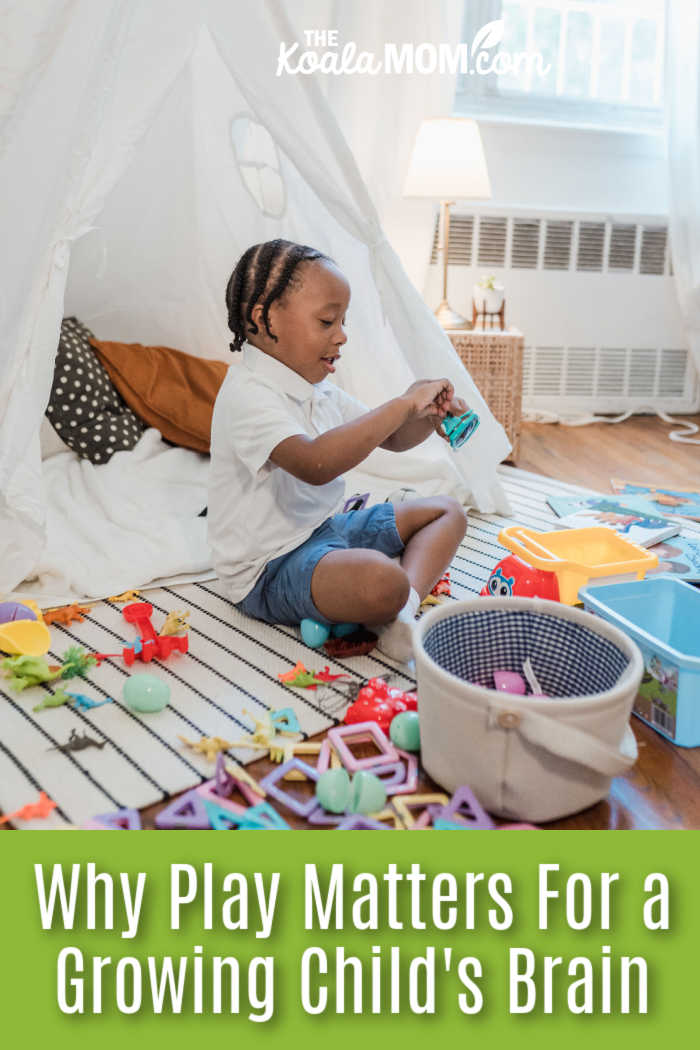
Play Builds Problem-Solving Skills
Open-ended play asks children to make decisions without receiving step-by-step instructions. Building with blocks, for example, requires a child to decide what to create, determine why a structure keeps falling, and try a different approach.
These small challenges exercise executive function skills such as planning, attention, working memory, and flexible thinking. A puzzle offers a similar experience. Children have to remember which strategies failed while considering what to try next.
Adults can support this process without immediately providing the answer. Asking a simple question such as, “What else could you try?” gives the child room to think through the problem.
Pretend Play Exercises Language and Memory
A cardboard box can become a spaceship one afternoon and a restaurant the next. Pretend play requires children to hold ideas in their minds while acting them out.
Playing restaurant, for example, involves remembering roles, creating conversations, taking orders, and deciding what happens next. Children practice vocabulary and storytelling while learning to organize a sequence of events.
Group pretend play adds another challenge. Children have to communicate their ideas while responding to what someone else wants the game to become.
These experiences are particularly valuable during the preschool years, when language, social skills, and self-control are developing rapidly.
Physical Play Connects the Brain and Body
Running, climbing, throwing, balancing, and jumping help children practice coordination and spatial awareness. The brain constantly processes information about body position, speed, distance, and surrounding objects during active play.
Fine motor activities matter too. Drawing, stacking small blocks, working with clay, and putting together puzzles require precise coordination between vision and hand movements. Those abilities later support everyday tasks such as writing, fastening clothing, and using utensils.
Social Play Teaches Emotional Control
Playing with other children does not always go smoothly, and that is part of its value. Someone changes the rules. Two children want the same toy. A game is lost.
These moments give children opportunities to practice waiting, negotiating, coping with frustration, and recovering from disappointment. Adults can provide guidance when necessary without solving every disagreement immediately.
Children Also Need Unstructured Time
Lessons, organized sports, and educational activities can benefit children, but a schedule filled with adult-directed activities leaves less room for independent choices. Unstructured play lets children decide what to do, change direction, experiment, and manage boredom.
Play supports brain growth because it combines thinking, movement, language, memory, and social interaction in ways that feel natural to children. Parents do not need elaborate toys or carefully planned activities to encourage it. Blocks, art supplies, outdoor spaces, household objects, and time with other children can provide plenty of opportunities.
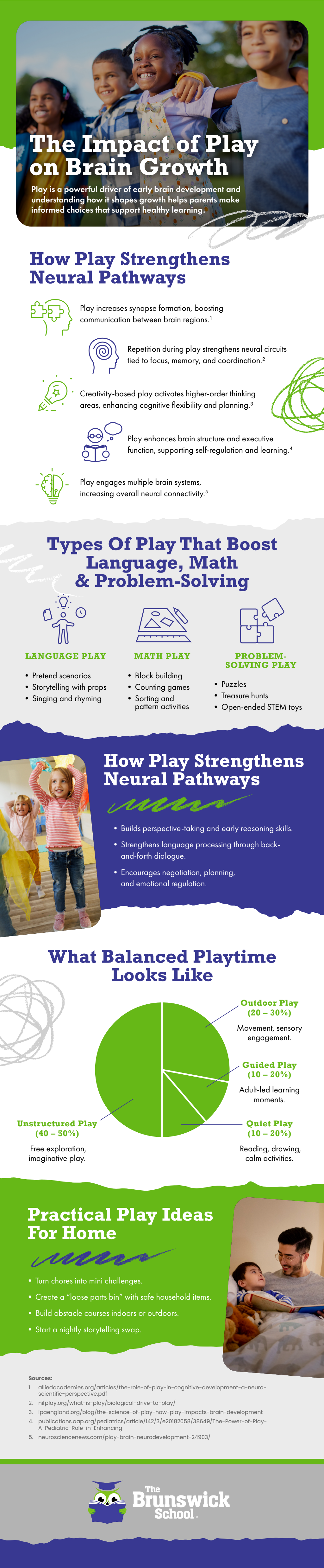
Check out the infographic below to learn more.


No Responses Yet