


When we’re choosing a home, it’s easy to focus on the house itself. How many bedrooms does it have? Is there enough room for the kids? Does it have a backyard? Is the kitchen big enough? But where that house is located can have just as much impact on family life as what’s inside it.
Think about your average weekday. How far do you have to drive to school? Can your kids walk to a friend’s house? Is the grocery store five minutes away or twenty? Is there a park nearby? What happens when it rains or snows? And how many times a day do you find yourself getting everyone into the car simply because there isn’t another practical option?
All of those little decisions add up. The places around us quietly shape our family routines, whether we realize it or not. Friends of ours once told us to buy a house for its location because you can change the house, but you can’t change its location. I’ve always appreciated that advice.
When I was house hunting for my current duplex, one of my biggest considerations was how my kids would get to school. As a single mom with younger kids still at home, I couldn’t drive them everywhere every day. I needed reliable public transit, which immediately ruled out several parts of our city that don’t have regular bus service.
These days, I really appreciate our central location. We can walk or bike to many places, and we can catch the bus when we need to go farther. That makes a surprisingly big difference in how our days work.
When a neighbourhood is designed around the needs of the people living there, family life can feel a little easier. When it isn’t, you can end up fighting the geography of your own life every day. We’ve spent a few years doing exactly that. Our kids attended a school in another city, about 30 minutes away, so a surprising amount of my week revolved around getting them back and forth. Add in activities and appointments, and I often felt like I was spending half my life driving.
This year, I’ve made a deliberate effort to keep our activities local. I’m looking forward to seeing what a difference that makes—not just in the amount of time we spend in the car, but in how much more breathing room we have in our week. Sometimes making family life easier isn’t about finding a better schedule. It’s about looking at where we’re going and asking whether everything really needs to be that far away.
The Daily Cost of a Long Commute
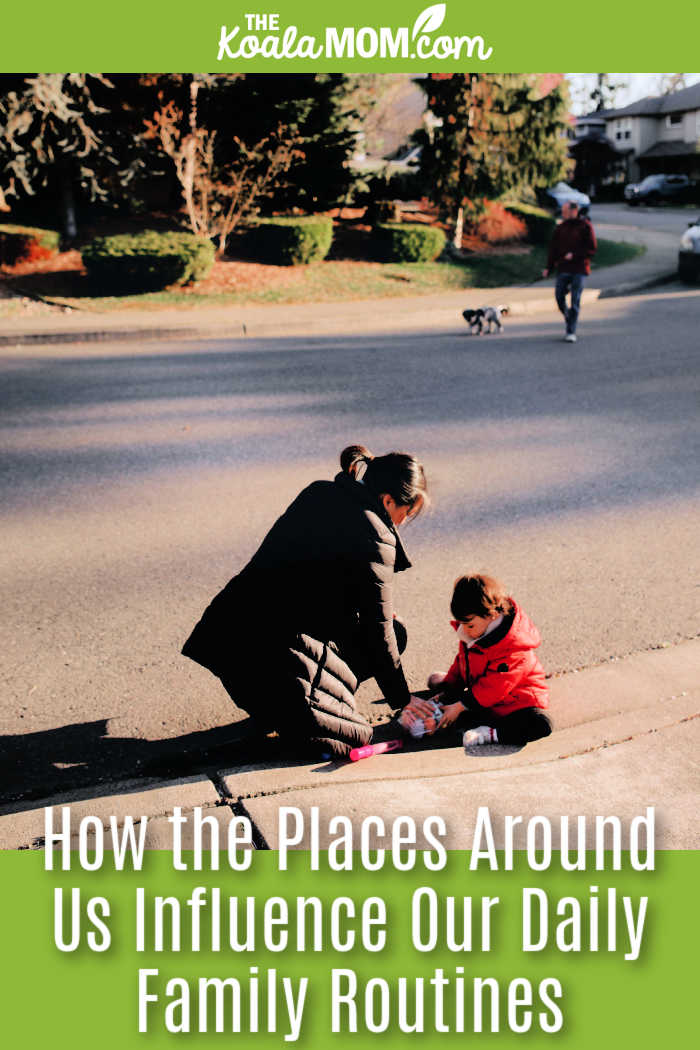
One of the biggest ways our surroundings affect us is through the amount of time we spend getting from one place to another. If your home is far from your children’s school, your workplace, the grocery store, and their activities, every one of those trips takes time and energy. Urban planners sometimes refer to this as spatial friction—basically, the effort required to get from one place to another.
And moms know exactly what that feels like. A 20-minute drive doesn’t sound terrible on its own. But add school drop-off, work, grocery shopping, soccer practice, another school pickup, and the drive home, and suddenly you’ve spent a large part of your day in the car.
And then something goes wrong. Traffic is backed up. The bus is late. Someone forgot their gym bag at school. Your toddler needs a bathroom right now. Suddenly the carefully planned evening falls apart.
Neighbourhoods with a mixture of homes, stores, services, and other amenities can make some of those trips much easier. If the grocery store, pharmacy, coffee shop, childcare, or other services are close to home—or conveniently located along a route you’re already taking—you don’t need to make a separate trip for everything.
The buildings themselves are part of that equation, too. The availability of local shops, childcare centres, offices, and other services often depends on the type and scale of commercial building construction. When communities allow different kinds of buildings and businesses to exist close to residential areas, families may be able to accomplish more without constantly getting back in the car.
What Happens Just Outside Your Front Door?
It’s not just the distance between different parts of the city that matters. Your immediate neighbourhood can make a difference, too. Think about what happens when you step outside your front door.
Are there sidewalks? Can your children safely ride their bikes? Is there a park nearby? Is it noisy? Do you have somewhere to go when everyone needs a change of scenery? These things might sound like small details, but they can have a surprisingly big effect on family stress.
Safe places for kids to get around
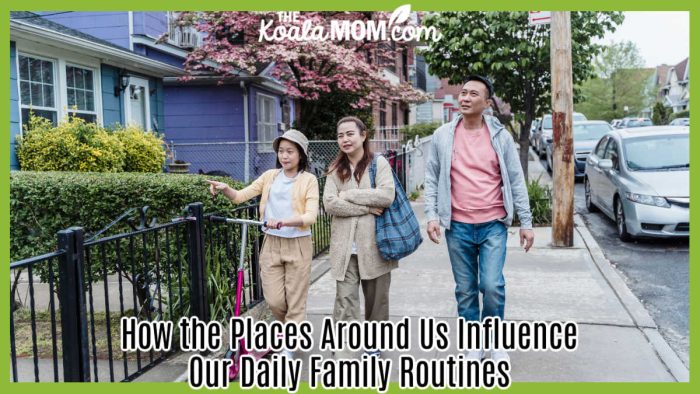
One of my favourite things about having a walkable neighbourhood is that my kids don’t always need me to drive them everywhere. Good sidewalks, bike routes, crosswalks, and lower-speed streets give older children more independence. They can walk to a friend’s house, bike to the library, or eventually get themselves to an activity without Mom acting as their personal taxi service.
Of course, safety matters. Our community has a provincial highway running through it, and we’ve had several fatal vehicle-pedestrian collisions. That makes me especially aware of how much neighbourhood design can affect whether kids can actually move around independently.
Parks become part of the house
A nearby park or community centre can almost feel like an extra room in your home. This is especially helpful if you live in a smaller house or have several children like me. You don’t necessarily need a huge backyard if there’s a great playground five minutes away.
Sometimes the kids just need to get out of the house. Being able to walk to a park gives everyone a change of scenery without requiring a complicated outing. And sometimes Mom needs that change of scenery just as much as the kids do.
Noise matters, too
We also don’t always think about how much noise affects family life. Constant traffic, construction, sirens, or other urban noise can make it harder to relax at the end of the day. A friend of mine recently moved from an urban area to a rural one, and she told me she noticed a huge difference in how everyone was sleeping.
That’s not necessarily an argument that everyone should move to the country. (Believe me, rural living has its own challenges!) But it is a reminder that our surroundings affect us even when we’re not consciously thinking about them. For families with children who are particularly sensitive to noise and sensory input, that environment can matter even more.
Your Neighbourhood Can Become Your Community
There is another benefit to having useful places close to home: you are more likely to actually use them. The library, playground, coffee shop, community centre, or little bakery around the corner can become more than just places you visit. They can become places where you see the same people regularly.
Sociologist Ray Oldenburg called these kinds of places “third places”—spaces outside our homes and workplaces where people gather and build relationships. For parents, those casual connections can be surprisingly important.
Sometimes community doesn’t come from joining another formal group or scheduling another playdate. Sometimes it’s simply seeing the same neighbour at the park every Tuesday or chatting with another mom at the library. Those little interactions can gradually become a support network.
Winter Changes Everything
Where you live also affects your routines differently depending on the season. In a place with mild weather like the lower mainland, walking to the park or community centre might be easy most of the year. In most other areas of Canada, however, the equation changes. When it’s -20°C, snowing, or raining sideways, suddenly that 10-minute walk doesn’t sound quite as appealing.
That’s why having indoor recreation centres, swimming pools, libraries, community centres, and other amenities reasonably close to home can make such a difference. If every activity requires a 30-minute drive, families may simply do fewer things during the winter.
When useful amenities are spread throughout a community rather than concentrated in one distant location, it’s easier for families to keep their routines going year-round.
What If You Can’t Move?
Of course, knowing that location matters doesn’t mean we can all simply move to our dream neighbourhood. Most families have plenty of other things to consider: housing prices, jobs, school options, childcare, family nearby, and whether we can actually afford the neighbourhood we’d love to live in.
Sometimes the house with the perfect location is completely out of our budget. Sometimes the house we can afford is nowhere near the school or work. Sometimes moving isn’t an option at all. But even when we can’t change our location, understanding how our surroundings affect us can help us work with them instead of constantly fighting them.
Group errands by location
Instead of organizing every errand around the time of day, try organizing some of them around where you’ll already be. If you’re already driving across town for your child’s activity on Tuesday, could you pick up groceries or make another necessary stop nearby while you’re there? If you’re going to the library, could you walk to the playground afterward instead of making another trip later?
This doesn’t mean turning every outing into a giant productivity mission. Sometimes it’s nice to go somewhere for just one thing! But grouping errands geographically can save a surprising amount of time.
Build in a transition
If your commute is stressful, don’t assume you have to walk through the front door and immediately switch into Parent Mode. Maybe you can sit in the car for five minutes before going inside. Take a short walk. Listen to a podcast or audiobook during the drive. Grab a coffee. Whatever gives you a little breathing room between work and home. That small transition can help you arrive home mentally as well as physically.
Pay attention to the trouble spots
Every family has certain parts of the week that seem unnecessarily difficult.
Maybe it’s the Wednesday afternoon rush between school and soccer. Maybe it’s Saturday mornings because the grocery store is 25 minutes away. Maybe it’s trying to get three children to different activities on opposite sides of town.
Instead of simply accepting that chaos as part of family life, look at what is actually causing it. Is it the distance? Traffic? Transportation? The timing of activities? A lack of nearby services?
Once you identify the problem, you may be able to find a workaround. Carpooling with another family, changing the day you shop, combining two errands, or choosing an activity closer to home can sometimes make a bigger difference than we expect.
Your Location Is Part of Your Family Life
We tend to think of our home as the place where family life happens. But really, family life spills out the front door.
The school down the road, the park around the corner, the grocery store ten minutes away, the bus stop, the library, the community centre—all of these places become part of our family’s daily rhythm. That’s why location matters so much.
The goal isn’t necessarily to find the “perfect” neighbourhood. Most of us couldn’t afford it anyway! It’s about noticing how the places around us affect our time, energy, stress, and opportunities for connection.
Sometimes a slightly smaller house in a convenient location can give a family more freedom than a bigger house that requires driving everywhere. Sometimes the best neighbourhood isn’t the trendiest one; it’s simply the one that makes your particular family’s life a little easier.
And when we can’t change where we live, we can still look at our routines and ask: What could we change to make this location work better for our family?
No Responses Yet