


This guest post is written by a friend of mine, who shares some family vacation tips based on her recent experience.
We booked a lake house in Oregon for our family vacation this year mostly because it slept nine and had a dishwasher. That was the entire decision-making process, if I’m honest. Nine beds, one dishwasher, close enough to drive.
What we got was a week where I barely saw my children indoors. They came in to sleep and to eat, and even the eating was negotiable.
I’ve thought about that house a lot since, because it wasn’t the lake that did it. We’ve stayed near water before and had kids parked on the couch by day two. Something about the way this particular house was built kept pulling everyone outside.
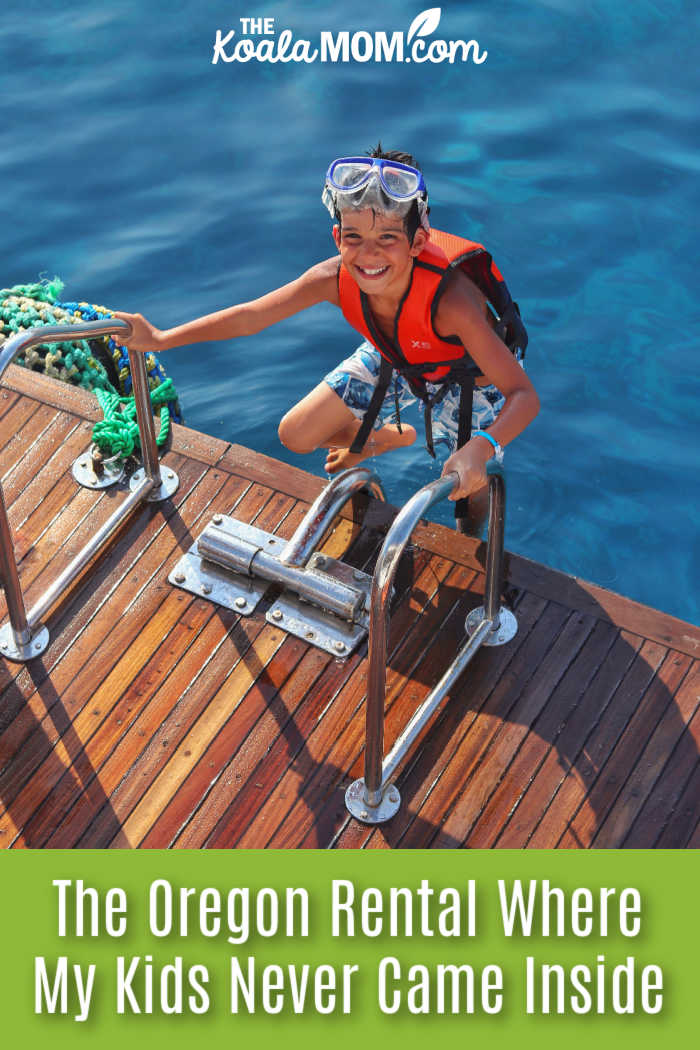
We drove down expecting an ordinary week
Vancouver to the Portland area is a manageable drive with kids, and we broke it up the way we always do now, with stops at playgrounds along the way. I mapped several good break locations before we left, to make sure the kids could stretch and the adults could get coffees.
We’d had our usual family meeting beforehand. One kid wanted swimming, one wanted a campfire, one wanted to be left alone with a book. Reasonable requests, all of them.
My expectations were modest. I assumed I’d spend the week doing what I usually do on vacation, which is repeatedly asking people to go outside instead of just sitting in their rooms on their devices like they’d been doing at home all summer.
That turned out to be unnecessary, and I’ve spent a while working out why.
The honest backdrop is that this is the exception rather than the rule for most families. The EPA notes that on average, people spend about 90 percent of their time indoors. And CDC guidelines say children and teens aged 6 to 17 need at least 60 minutes of moderate-to-vigorous activity every day, which sounds easy until you count what a rainy Tuesday actually looks like in our house.
Why the water views changed how we used the house
The layout was the thing. I didn’t have language for it at the time.
The main living space had windows running floor to ceiling along the entire lake side, with sliding glass doors in the middle that opened onto a deck. The kitchen faced the water too, rather than staring at a wall the way ours does at home.
So wherever I was standing, I could see all four kids. That single fact changed everything about how the week went.
At home, letting the younger ones outside means going outside with them, or standing at a window with a poor angle, or checking every few minutes, or bribing my teenager to babysit for me instead of scrolling his phone. At that vacation house, I could load the dishwasher and watch my six-year-old throwing rocks off the dock.
PortlandRealEstate.com breaks down the design details that maximize water views in homes built along the water, and reading it afterward named almost everything I’d noticed without being able to articulate.
Corner windows. Open floor plans that put the kitchen and living space nearest the view. Closets and pantries pushed to the walls without a view. It’s all deliberate, and it works.
The other effect was that going outside stopped being a decision. When the door you look through is also the door you walk through, kids drift out constantly instead of making a production of it.

The features that actually mattered
Looking back, a few specific things did the heavy lifting:
- A door on the water side. Not around a corner. Right there.
- A covered deck. It rained twice. Nobody came in.
- Low windows. Even my toddler could see out without climbing on furniture.
- Outdoor seating for everyone. Meals happened outside by default.
- A visible dock. Sight lines meant supervision without hovering.
None of that is luxury. It’s just orientation. I’ve since noticed how many houses, including mine, treat the best view as something you visit rather than something you live in front of.
What I learned about light
The other thing I noticed was how the house felt at different times of day, which I later realized was also by design.
Daylighting guidance from the Department of Energy explains that south-facing windows let in the most winter sun while admitting little direct summer sun when properly shaded, north-facing windows give even light with almost no glare, and east- and west-facing windows deliver good morning and evening light but can bring glare and unwanted summer heat.
Our rental had deep overhangs on the water side. Mornings were bright without being blinding, and the afternoon sun didn’t turn the living room into an oven.
I came home and looked at our own house properly for the first time in years. Our kitchen window faces west, which explains why I can’t see anything at dinnertime and why that room bakes in August.
Not much I can do about it now. But I notice.
The safety part I won’t skip
A house that makes it easy for kids to be near water also makes it easy for kids to be near water, and I want to be clear-eyed about that. We set rules on the first afternoon.
Nobody on the dock alone. Life jackets on before anyone touched a boat, not after.
That isn’t just parenting preference in Oregon. Oregon’s marine board requires that children 12 and under wear a U.S. Coast Guard-approved life jacket whenever a boat is underway, with narrow exceptions for enclosed cabins. We brought our own, because rental life jackets are a gamble on sizing, especially for skinny kids.
Good sight lines are not a substitute for supervision. They just make supervision sustainable, which matters when you’re the only adult in the kitchen.

What I’d look for next time
I’ll never again book purely on bed count. I’ll look at where the windows are and what the door situation is on the side that matters.
I’ll ask for photos taken from inside looking out, not the other way around. Listings always show the house from the water. Almost none show the water from the house.
And I’ll pay more for a covered outdoor space than for an extra bedroom, which is not something I would have said two summers ago.
The week cost roughly what any other week would have. What was different was that I spent it watching my kids play instead of persuading them to.
That’s the whole review, really.
No Responses Yet