


One of the beautiful things about homeschooling is that learning doesn’t have to stay inside four walls or happen in a desk and chair. Some of the best lessons happen outdoors—on a nature walk, during a family hike, or while exploring a nearby forest.
For many neurodiverse children, especially kids with ADHD, outdoor learning can be a game changer. I’ve seen this in my own homeschool. My son often struggles to sit still long enough to focus on a math or reading lesson, but put him outside and something shifts. He becomes calmer, more engaged, and surprisingly attentive to the world around him. Movement, fresh air, and sensory input often help children regulate their bodies and minds in ways that traditional desk work simply doesn’t.
That’s one reason forests make such wonderful classrooms (and many parents and educators are exploring “forest school” options). They invite curious, hands-on learning without requiring kids to sit quietly or absorb information in just one way. Children can move, touch (carefully), observe, ask questions, and learn at their own pace.
Teaching our children about forests also gives us a beautiful opportunity to connect science with faith. As Catholic homeschoolers, we believe creation reveals something of its Creator. When we study towering trees, tiny ecosystems hidden under fallen logs, or the intricate way plants and animals depend on one another, we’re witnessing the wisdom and creativity of God. As we see the diverse and creative world God has created, we can also better appreciate our own diversity and creativity.
Why Forest Education Matters
Children are naturally curious, especially when they’re given the freedom to explore outdoors. Time spent in wooded areas invites questions: Why do some trees lose their leaves? Who lives inside fallen logs? Why do certain birds prefer certain trees?
By observing plants, insects, birds, and animals in their natural habitats, kids begin to understand biodiversity in a meaningful way. This is especially true when we have the opportunity to revisit our favourite forests over several seasons and see how it changes during that time.
These moments can become opportunities not only for scientific discovery but also for wonder and gratitude. Forest walks can naturally lead to conversations about stewardship—how God entrusted creation to humanity not for exploitation, but for responsible care. Teaching our children to appreciate forests helps them understand both the gift of creation and our responsibility to protect it.
Forests also help children see the practical importance of nature. Healthy woodlands clean the air, help filter water, and provide shelter for countless species. These aren’t just abstract science concepts—they’re real systems our families depend on every day. We talk regularly about walking on the path to help protect the tree roots and smaller plants, and about leaving sticks and stones where we find them because those are habitats for animals and insects.
Hands-on learning often sticks better than textbook lessons. When children can see healthy ecosystems for themselves, conversations about conservation and stewardship become much more meaningful. Often, in fact, these conversations are started by my children, out of their own observations and curiosity, instead of me trying to convince them this is something important.
Understanding the Life Cycle of a Tree
A simple way to begin studying forests is by learning about the life of a tree.
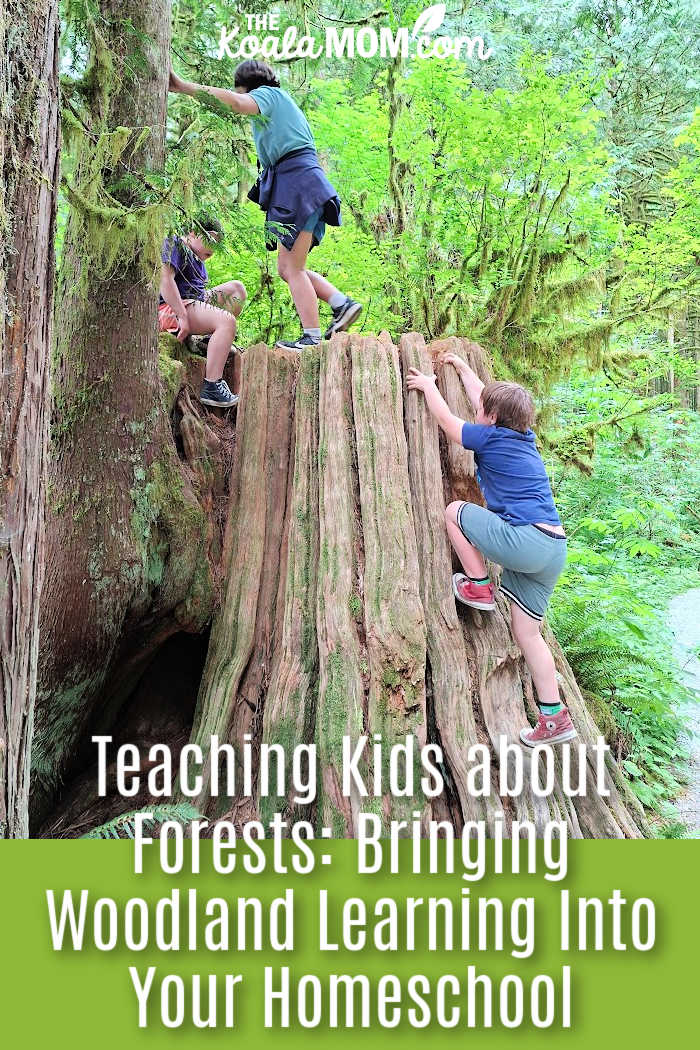
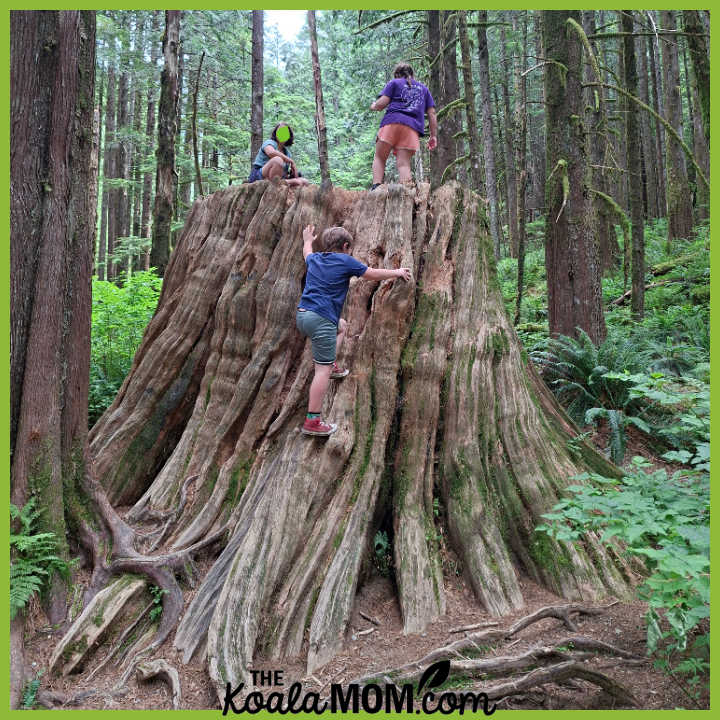
Kids can explore how tiny seeds grow into saplings, mature into towering trees, and eventually return nutrients to the earth as they decay. This natural cycle offers a wonderful introduction to biology and ecology. For example, my kids love noticing “nurse trees” when we’re out hiking. These are huge old stumps that are now growing ferns, trees and other plants as they decompose.
It’s also a great opportunity to talk about photosynthesis in practical terms. Even younger children can understand that trees take in carbon dioxide and release oxygen—making them essential for life on Earth.
If you can find a tree stump or a cross-section of a log, studying growth rings can be especially fascinating. Those rings tell a story about the tree’s age, growing conditions, drought years, and even damage it survived. We’ve seen the damage left by forest fires and lightning strikes in forests around us.
Teaching Kids About Sustainable Forestry
Many children assume cutting down trees is always harmful, so it’s helpful to explain sustainable forestry.
Responsible forestry means harvesting trees in a way that allows forests to regenerate and remain healthy for future generations. In well-managed forests, trees are harvested carefully so removal does not exceed natural regrowth or replanting efforts. Modern forestry practices also prioritize habitat protection, soil health, and long-term ecosystem balance.
One helpful concept to teach children is selective harvesting. Rather than clearing entire sections of forest, foresters often remove specific trees while preserving much of the surrounding canopy. This helps reduce soil erosion, protect watersheds, and preserve habitats for birds and other wildlife.
This helps children understand an important truth: using natural resources and protecting nature don’t have to be opposites.
As families, we can put these lessons into practice in everyday life. If you’re tackling a home renovation, replacing furniture, or building a backyard project like a raised garden bed, treehouse, or birdhouse, it can be worth looking for sustainable wood products sourced from responsibly managed forests. Choosing certified wood helps support forestry operations that replant trees, protect vulnerable ecosystems, and steward natural resources carefully.
These real-life decisions show our children that stewardship isn’t only something we talk about during science lessons—it also shapes how we spend, build, and care for our homes.
When managed responsibly, forests can continue supporting wildlife, protecting watersheds, and supplying useful materials for our communities for generations to come.
Using Multimedia to Learn About Forestry
Not every homeschool lesson needs to come from a textbook—or even from the forest itself.
Sometimes videos, documentaries, and online learning resources can help elementary students understand parts of forestry that are harder to observe firsthand, such as modern logging practices, sawmills, or lumber production. Resources like Into the Outdoors offer family-friendly videos and lessons that help explain the journey from seedling to finished wood products.
These kinds of resources can be especially helpful for visual learners or neurodiverse children who benefit from seeing a process in action. Watching how trees are harvested, transported, milled, and turned into usable materials helps bridge the gap between the forest and the everyday products in our homes.
Multimedia learning can also spark great conversations. Children may begin noticing just how many household items depend on wood—from bookshelves and kitchen tables to pencils and paper. Understanding this process helps them develop a more balanced view of forestry, recognizing both the importance of protecting forests and the value of responsibly managed natural resources.
For homeschool families, these resources can add variety to your lessons and provide a helpful framework for discussing more complex topics like commercial harvesting, conservation, and sustainable resource management.
Hands-On Forest Activities for Homeschool Families
Forest education doesn’t need to be complicated. Simple hands-on activities can make learning both memorable and fun.
Try activities like:
- collecting leaves and identifying tree species
- making bark rubbings
- starting a nature journal
- building a birdhouse or simple wooden craft
- planting a tree or caring for a sapling
These activities help children connect scientific concepts with real-world experience. Even regular family walks can become rich learning opportunities when we slow down and observe what’s around us.
Understanding the Economic Role of Forests
Forests are not only important environmentally—they also support communities and livelihoods. Tie some career education into your forest walk and science discussions by looking at how many jobs are connected with trees.
The forestry industry provides careers for many people, including foresters, loggers, mill workers, builders, and craftspeople. Trees also supply raw materials used in construction, paper products, furniture, and countless household items.
Teaching kids about this side of forestry helps them understand the balance between conservation and practical resource use.
Wood is also a renewable resource. Unlike fossil-fuel-based materials, trees can be replanted and regrown when forests are managed responsibly. Unlike plastics and some other materials made from fossil fuels, wood can also be easily recycled, either into other products or simply by decomposing.
Raising the Next Generation of Stewards
One of the greatest gifts we can give our children is a sense of responsibility for the world around them.
When kids understand how forests function—and why they matter—they grow into adults better equipped to make informed decisions about conservation and sustainability. For Catholic families, stewardship is more than an environmental talking point; it is part of how we live out our faith.
Helping our children care for creation teaches them that gratitude should lead to action. When they learn to notice beauty, respect resources, and care for living things, they begin developing virtues like responsibility, humility, and reverence.
Small experiences matter. A child who learns to love forests today may become the adult who protects them tomorrow.
Teaching our kids about forests doesn’t require formal lessons or complicated curriculum. Sometimes all it takes is stepping outside, slowing down, and noticing the wonder God has placed around us.
No Responses Yet