


I’ve often heard people say that ADHD is a “modern problem” or that it seems to be becoming more common. I have two theories about why that perception exists.
First, our understanding of neurodevelopmental conditions has grown enormously in recent decades. As awareness has increased, we have become better at recognizing differences in attention regulation, executive functioning, and impulse control that might once have gone unnamed.
Second, ADHD traits often become most noticeable in environments that demand prolonged focus, rigid structure, and sustained self-regulation—school being one of the clearest examples. In earlier generations, less standardized educational and work environments may have allowed some ADHD traits to go unnoticed or even prove advantageous.
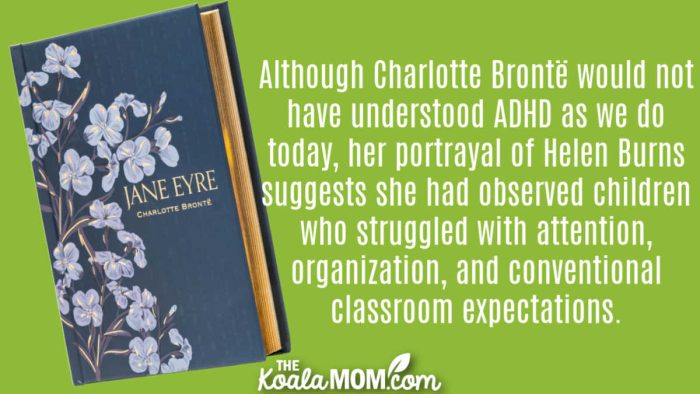
This tension appears in Jane Eyre, where a minor character displays traits that many modern readers might recognize as consistent with ADHD. Although Charlotte Brontë would not have understood ADHD as we do today, her portrayal of Helen Burns suggests she had observed children who struggled with attention, organization, and conventional classroom expectations.

This post contains affiliate links; as an Amazon associate, I earn from qualifying purchases.
Jane Eyre meets Helen Burns when she arrives at Lowood School at around age eleven. Until then, Jane has been raised by her aunt in accordance with her dying uncle’s wishes, but she suffers severe mistreatment in her aunt’s household. After finally resisting her cousin’s bullying and being harshly punished for it, Jane is sent away to school. Lowood becomes a turning point in her life, where she finds both a mentor in Miss Temple and a friend in Helen Burns.
Helen’s Symptoms of Inattentive ADHD
What Jane first notices about Helen is how harshly one of the teachers treats her, seeming to punish her for every small fault. Jane, with her strong sense of justice, is outraged and asks Helen why she tolerates such treatment. Helen responds with characteristic calm, explaining that her family sent her to Lowood to receive an education and that she has a duty to do so. She also admits that she has significant faults. She describes herself to Jane:
I am slatternly; I seldom put, and never keep, things in order. I am careless; I forget rules; I read when I should learn my lessons; I have no method; and sometimes I cannot bear to be subjected to systematic arrangements. Even my beloved teacher’s expostulations, so mild, so rational, have not influence to cure me of my faults; and even her praise, though I value it most highly, cannot stimulate me to continued care and foresight. My thoughts continually rove away from the lesson; when I should be listening, often I lose the very sound of the teacher’s voice. I fall into a sort of dream. Sometimes I think I am far away and that the noises around me are a bubbling little brook, and when it comes my turn to reply, I have to be awakened, and having heard nothing of what was read, for listening to the visionary brook, I have no answer ready.
When I first read that passage, I immediately thought, These traits sound like what we would now recognize as inattentive ADHD. Helen’s description of herself reflects several common hallmarks:
- Chronic distractibility and “zoning out”
- Deep internal absorption (the dream or brook imagery)
- Difficulty sustaining attention even when she genuinely wants to do well
- Limited response to external motivators such as praise or correction
Helen’s explanation to Jane is, of course, a literary self-description rather than a clinical assessment. Her language is also shaped by her era. She describes herself in moral terms—“careless,” “slatternly,” “without method”—rather than neurological ones. What we would now understand as differences in executive functioning was historically framed as a failure of discipline or character. Like Jane, Helen may have been sent away to school as much for “discipline” and “character formation” as for academic instruction.
One important limitation in reading Helen through an ADHD lens is that we encounter her only in the school setting. Still, her conversation with Jane suggests these struggles were present at home as well. Modern ADHD diagnosis involves persistent patterns across multiple settings—school, home, and social life—beginning in childhood and causing meaningful impairment. Occasional inattention or daydreaming alone would not be sufficient.
There is another important nuance: in Helen’s time, traits we might associate with ADHD were often interpreted through moral or spiritual frameworks. She is punished for behaviours that adults see as signs of carelessness, laziness, or disobedience. Yet Helen is not simply inattentive. She is also portrayed as deeply ascetic, introspective, and detached from the material world. Her wandering mind is tied not only to attention difficulty but also to spirituality and contemplation.
In this sense, Brontë seems to intentionally contrast Helen with Jane. Helen is inward, submissive, and transcendent; Jane is grounded, emotionally reactive, and action-oriented. Helen’s inattention may resemble ADHD, but it also serves a larger literary purpose, reinforcing her role as Jane’s spiritual counterpart and moral guide.
How Does School Affect ADHD?
Institutions like Lowood School reflect a broader educational reality of the time. Schooling emphasized:
- strict routine and obedience
- rote learning
- suppression of individuality
- moral “improvement” through discipline
Within such a system, a child who struggled to conform was rarely seen as simply different; instead, they were seen as needing to be corrected. Punishment, shame, and moral instruction were the primary tools available. Both Jane and Helen are expected to fit into a rigid box of acceptability—to become as uniform inwardly as they appear outwardly in their school uniforms.
What is especially interesting is that Charlotte Brontë does not fully endorse that system. Through Helen, she does something subtle but significant:
- She shows a child who genuinely tries but still cannot meet expectations.
- She portrays that child as gentle, intelligent, thoughtful, and deeply admirable.
- She suggests that external discipline does not actually “cure” the underlying struggle.
So while Helen interprets herself in moral terms—“my faults”—the narrative invites readers to question whether that judgment is fair, or at least complete. In modern terms, we might say:
- Helen lacks support for the way her mind works.
- The educational environment is rigid and poorly suited to her needs.
- Her “failings” are not entirely under voluntary control.
In Jane and Miss Temple, we see two different responses to Helen’s struggles.
Jane represents moral outrage at the unfairness of the expectations placed upon Helen. While many students appear better able—or more willing—to comply with Lowood’s rigid structure, both Jane and Helen struggle within it, though for different reasons. Neither fails for lack of effort. Jane’s anger reflects her recognition that Helen is judged primarily by outward compliance rather than inner character. Helen, by contrast, seems to have internalized those judgments. Having long been treated as inadequate, she no longer resists being labeled “not good enough.”
Miss Temple offers a striking alternative. Unlike the harsher teachers at Lowood, she is gentle, patient, and attentive to each student as an individual. She encourages both Jane and Helen as best she can within the school’s constraints. Her decision to invite the girls to her room for tea is especially telling: she offers not merely academic instruction but emotional care.
In many ways, Helen’s story suggests that ADHD is not simply about individual weakness or lack of discipline. Struggle often emerges from the relationship between a person and their environment. Helen is every bit as intelligent and capable as Jane or the other girls, but she needs understanding, flexibility, and support in order to thrive.
Helen Hides Her ADHD
One modern concept that may also help explain Helen’s experience is masking—the conscious or unconscious suppression of natural behaviours in order to appear more socially acceptable. Many neurodivergent people learn to hide traits that draw criticism, even when doing so is exhausting.
Helen’s response to Lowood suggests she has already learned this kind of adaptation. Rather than resisting the school’s judgment, she has absorbed it, speaking of her attention struggles as moral failings and striving to suppress the parts of herself that do not fit expectations. In some ways, Helen’s mentorship of Jane reflects this as well. She repeatedly encourages Jane to restrain her passionate emotional responses, endure injustice quietly, and cultivate outward composure. By the time Jane leaves Lowood, she appears “disciplined and subdued”—having learned, at least outwardly, how to conform.
Seen through a modern lens, this raises an uncomfortable question: is Helen teaching Jane wisdom and self-control, or survival through masking? Perhaps the answer is both.
What We Can Learn Today from Helen Burns
Of course, we can’t diagnose a fictional nineteenth-century schoolgirl with ADHD, nor should we try to reduce Helen Burns to a modern label. But reading Helen through that lens offers something valuable. It reminds us that neurodivergence is not a modern invention, only our language for describing it is. Long before terms like executive dysfunction or inattentive ADHD existed, there were children like Helen—bright, thoughtful, imaginative children whose struggles were mistaken for laziness, carelessness, or moral failure.
Perhaps that is what makes Helen’s story feel so familiar even now. The tragedy is not simply that she struggles to pay attention, but that she has learned to interpret those struggles as evidence of personal fault. In that sense, Helen’s story asks a question that still matters today: when a child cannot thrive within a system, is the problem always the child—or might the system need to change?
If you’re a fellow Bronte fan, or just curious about other views of literary characters, you may enjoy:
No Responses Yet