


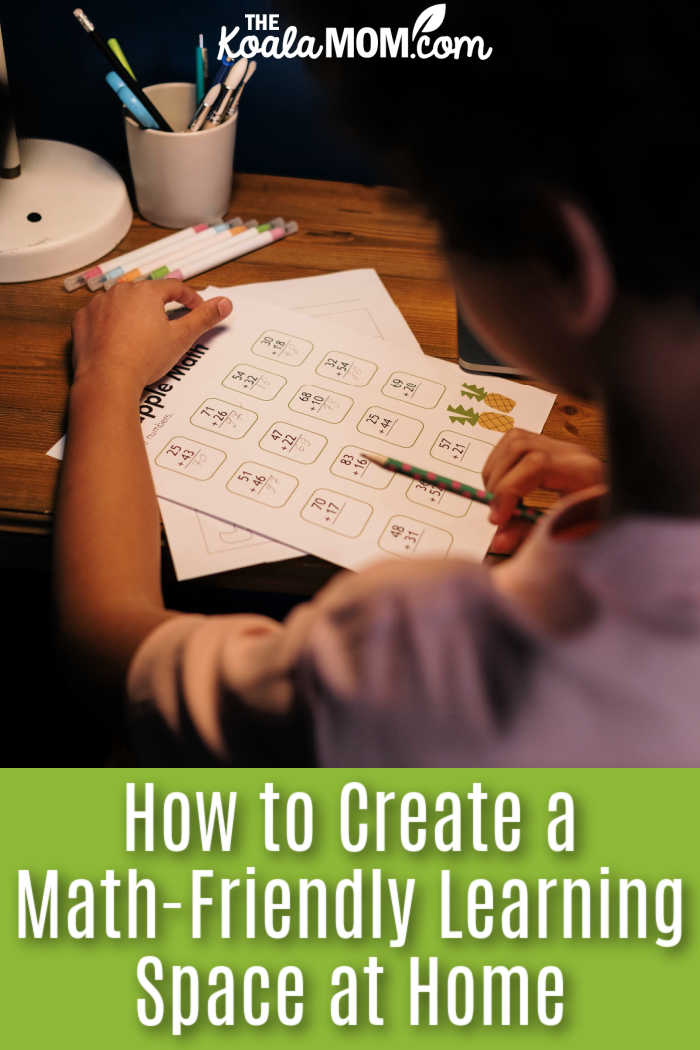
Math homework doesn’t have to end in tears every night. Whether your child loves numbers or struggles with them (as most of my kids do), having a consistent place to work can make homework time a lot less stressful. You don’t need a dedicated homeschool room or expensive furniture, either. With a little planning, almost any corner of your home can become a calm, math-friendly learning space.
Why the Right Space Changes Everything
Kids don’t separate their feelings from their surroundings the way adults often do. A cluttered table, a blaring TV, or a sibling arguing nearby can make it much harder to concentrate. If your child already feels anxious about math, those extra distractions only add to the frustration.
Having a consistent place to do math won’t solve every struggle, but it removes one obstacle. Over time, that familiar spot becomes associated with focusing instead of fighting through homework.
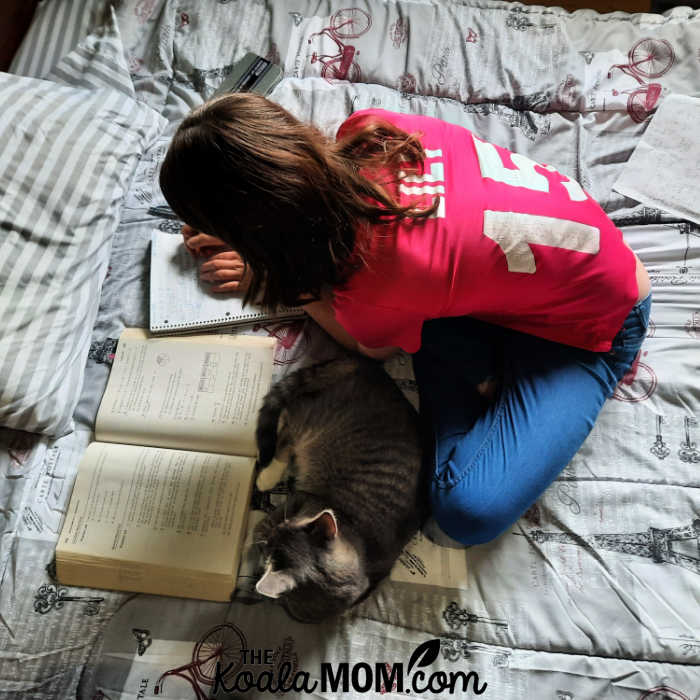
For example, one of my daughters spent grade 7 doing her math homework on my bed. She’d gather her textbook, notebook, pencil, rulers, and cat and head to my room, where she could close the door on the noise the rest of her siblings were making. The consistency and quiet there helped her get her math done every single day.
Choosing the Right Location
Not every home has a spare room, and that’s fine. Consistency matters in a study space more than square footage. A kitchen nook works if it’s used at the same time daily. A bedroom corner works too, as long as it isn’t also the spot for naps or video games.
Natural light helps more than people expect; daylight exposure is often linked to better mood and concentration. No window nearby? A warm desk lamp is a decent stand-in. Just skip dim overhead lighting — it tends to make everything, math included, feel heavier.
Furniture that Supports Focus
A chair that’s too big or too small can become a distraction all by itself. Younger children may focus better with furniture that’s sized for them instead of adult dining chairs.
For my son with ADHD, tying an exercise band between the chair legs gave him something to push against with his feet without constantly rocking his chair or kicking the table. My kids have also done math sprawled across the floor or lying on a bed (just like my brother did when we were homeschooled kids).
Every child is different, so don’t be afraid to experiment. While some kids focus best sitting upright at a desk, others—especially neurodivergent children—may think better when they’re allowed to move or choose a more comfortable position.
Whatever setup works best, try to keep the actual workspace fairly simple. One water bottle, one pencil cup, and the materials needed for today’s lesson are usually enough. Less visual clutter means fewer distractions.
Stock the Space with the Right Supplies
Keeping supplies within easy reach prevents interruptions once your child gets started. A few sharpened pencils, a good eraser, a ruler, graph paper, and (for older students) a simple calculator cover most math lessons.
During the early elementary years, we also kept math manipulatives in a nearby cubby. Counting bears, linking cubes, number lines, and pattern blocks stayed tucked away when we weren’t using them but were easy to grab whenever someone got stuck. My son especially liked pulling out a number line when subtraction became frustrating.
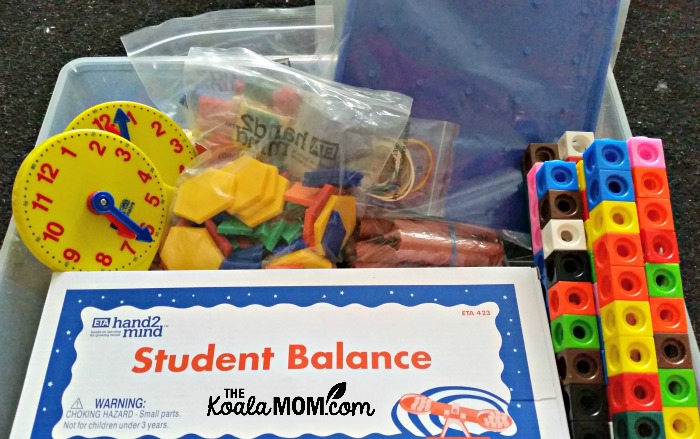
It also helps to keep everything together in a small caddy or basket instead of scattering supplies through different drawers. Every minute spent hunting for a protractor or ruler is another chance for a child to lose focus.
Let a Math Solver Step In When Stuck
Even a well-organized space can’t prevent every stuck moment. That’s where a math solver earns can be a helpful tool – not as a shortcut, but as a learning aid that shows each step instead of just the final answer. This is both a way to solve math homework fast and a way to improve your math skills. A child who types in a tricky equation and watches it unravel line by line often understands the method better than one who simply copies a number from the answer key.
Small Details: Lighting, Sound, and Temperature
Background noise affects every child differently. Some of my kids concentrate best with instrumental music playing quietly in the background—we’ve listened to the How to Train Your Dragon soundtrack more times than I can count—while others need complete silence. Try both and see which helps your child stay focused.
Temperature plays a quieter role but still matters. A stuffy, overly warm room makes anyone drowsy, and drowsy brains don’t multiply fractions well. Keeping the space slightly cool, close to 20 degrees Celsius, tends to keep attention sharper for longer.
Build a Simple, Repeatable Routine
Pick a time and stick to it, even on low-motivation days. Twenty to thirty minutes right after a snack works well for most elementary-age kids, with a short break if the lesson or homework is a bit longer or more intense.
Routine beats motivation almost every time. Motivation comes and goes, but a fixed schedule quietly does the work of habit — and habit is what actually gets homework finished without a nightly battle.
Routines are especially helpful for neurodivergent kids, who often do better when they know exactly what to expect next, even on days when motivation is low.
Track Progress without Turning It Into a Contest
A small progress chart on the wall — stickers for finished worksheets, a checkmark for solved word problems — gives kids something tangible to see growing. Keep rewards small and frequent instead of saving everything for one big prize at month’s end. Many neurodivergent kids find immediate rewards much more motivating than working toward something that’s still weeks away.
Once a week, glance at what’s working and what isn’t. Maybe the lighting needs adjusting, or the routine needs to shift earlier. A math-friendly learning space isn’t static; it should flex a little as confidence grows.
Keep the Mood Encouraging, Not Pressured
Above all, try to keep math time encouraging instead of stressful. Praise effort, persistence, and problem-solving—not just correct answers. When children know mistakes are simply part of learning, they’re much more willing to keep trying.
The goal isn’t to create a picture-perfect study space. It’s to create a place where your child feels safe to learn, ask questions, and build confidence one lesson at a time.
No Responses Yet