
)
)
Saint Helena is best known for discovering the True Cross some 300 years after Jesus’ crucifixion and for being the mother of Constantine, the Roman emperor who converted to Christianity. Like St. Monica, another mother of a famous Catholic saint, St. Helena could be considered a Church Mother for her contributions to the early Christian world. In his novel The Living Wood, Louis de Wohl brings her story to life, tracing her journey from a pagan British girl to a venerable Empress-Mother.
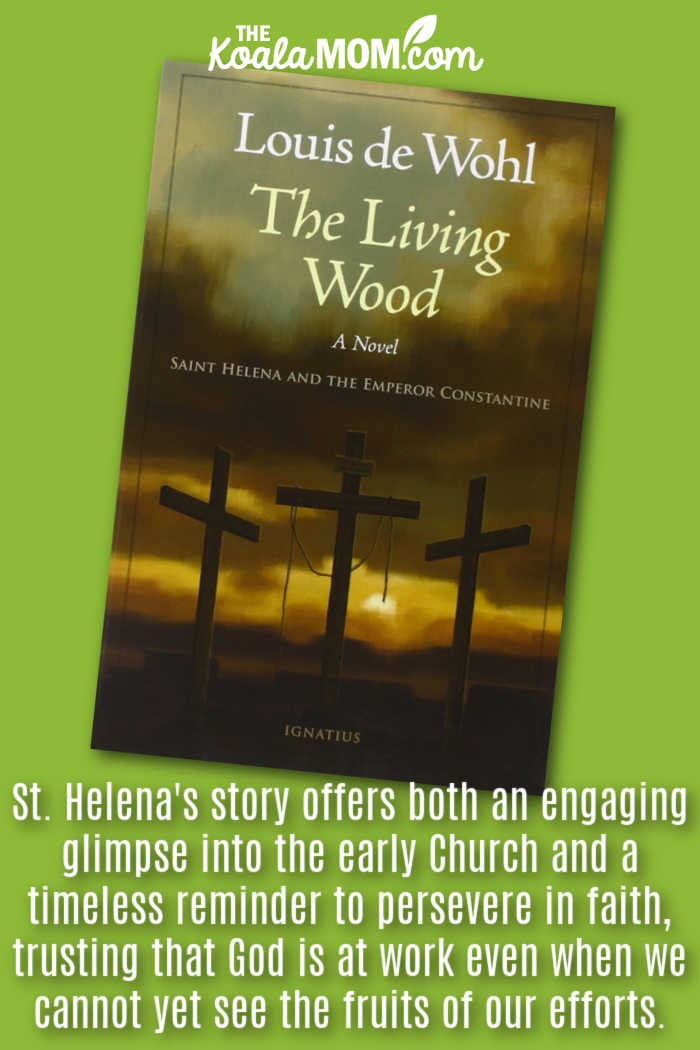
This post contains affiliate links; as an Amazon associate, I earn from qualifying purchases.
Plot Summary
The Living Wood opens in AD 272, when Constantius becomes lost in the fog in Roman-occupied Britain and encounters Elen, the daughter of a local tribal ruler. Her disdain for all things Roman is obvious, but she offers him the hospitality her father would expect of her. Constantius’ commanding officer encourages his interest in the young woman, and they are married.
Helena’s labor with her son Constanine is difficult, and her father offers a mysterious prophecy about his grandson. The story then jumps ahead over happy family years. Constantius is a generous, well-liked Roman ruler, Helena is his partner, and their son is being trained in the ways of a Roman soldier. But their happiness is interrupted when Constantius is summoned back to Rome to deal with political affairs.
While he is away, Britain falls to a rebel. Helena and Constantine are forced into hiding, living as a widow and her son, while Constantine does everything he can to persuade the Roman emperors to let him reconquer Britain.
When Constantius finally returns to reclaim Britain, the victory comes at a steep price. To secure an army, he has had to repudiate Helena. All her efforts to prepare for his return come to nothing, and she retreats once more into the role of a widow. One of her servants introduces her to Christianity, but Helena, consumed by anger and bitterness, questions and rejects what she hears. Then the persecution of Christians under Emperor Diocletian becomes personal, and Helena sets aside her pride to plead with Constantius Caesar for justice.
Their reunion is brief. Constantius dies, leaving his son to succeed him as emperor. With the rest of the Roman Empire in turmoil under rival caesars and emperors, Constantine leads his army across Europe. Helena travels with him, and the soldiers begin to recognize her Christian faith.
Just outside Rome, Constantine experiences his famous conversion. His troops face a larger, stronger army sent against them by a rival emperor, but under the sign of the cross, Constantine wins the victory that will change the course of history.
Years later, in AD 326, Helena is summoned from her British villa back to Rome to deal with a family tragedy involving Constantine’s household. The tragedy inspires her to search for the True Cross—the Living Wood her father had so often spoken about. We follow her to Jerusalem, where she meets a bishop and the local people as she searches hill after hill around the city. When the cross is finally found and its authenticity confirmed by a miracle, Helena carries it back to Rome. There, she dies a saintly death.
What I Liked
Louis de Wohl’s characters leap off the page. They feel real, complicated, and relatable. Too often, we picture saints as rather one-dimensional figures who loved God and accomplished one great thing in their lives. Helena and the people around her are much more complex than that.
I knew some of the details of St. Helena’s story, but I had always pictured her husband as a rather despicable figure. De Wohl takes the time to explore his actions and motivations, along with those of the other characters. He helps us understand why they make the choices they do, even when we might not agree with them.
In the opening scenes, Constantius comes across as a somewhat bumbling Roman soldier—the stereotypical conqueror, rather like John Smith meeting Pocahontas. Helena has little patience for him. She tells her father, “I don’t want to marry him… He is arrogant and condescending, and he treats my will as though it were a plaything.” Her father responds, “You are angry because you cannot rule him. But if you could rule him, you would despise him.”
I found Helena and Constantius’ courtship a little rushed, but de Wohl continues to develop their relationship throughout the novel. We come to see them as two strong people who respect each other. Both mature from the hot-headed young adults they were when they first met. They clearly love each other, and they are well matched as rulers, each capable of thinking strategically and making difficult decisions.
Their relationship feels like a meeting of equals: two people who love and respect each other despite their very different backgrounds. It is all the more tragic, then, that politics ultimately drives them apart.
I also appreciated the conversations between Helena and the Christians she encounters. After hearing this story told for nearly two thousand years, it is easy to forget how Christianity might have appeared to someone encountering it for the first time. Helena does not embrace faith immediately. Instead, she asks difficult questions and pushes back against what she hears.
Nor does becoming a Christian solve all her problems or make her life easier. Near the end of the novel, we see her wrestling with difficult questions once again, particularly about her son’s actions. She had expected Constantine to behave better as a Christian emperor, and she struggles to reconcile his failings with his faith.
Her bishop challenges her:
You are in grave error—so grave that it can well endanger your own soul. Guard that—before you take the responsibility for the soul of another, be it even your own son. What a proud woman you are—to think as you do! Do you really believe that only an entirely faultless man can be the instrument of God? Think of the Apostles—did they not desert their Lord—all of them—when the guards came to capture him? … I tell you, there has been only one faultless Man throughout all the ages of mankind. All of us can only *try* to follow his footsteps as best we can…
The bishop’s words offer an important reminder for parents: we are not responsible for another person’s choices, even when that person is our own child. Each of our children must make their own decisions and walk their own journey of faith. They will not do so perfectly, any more than we do.
Constantine had plenty of faults, as did Helena and many other saints. Yet they loved God and tried to follow Him as best they could. That is part of what makes the saints such powerful examples for us. They are not people who never stumbled; they are people whose lives can still point us toward heaven, even when their journeys were far from perfect.
Another theme that resonated with me is the struggle to remain hopeful in a troubled world. We know what eventually happened to the Roman Empire, and we can look around at our own society and feel discouraged by the problems we see. Sometimes, fighting against evil can seem futile, especially when we wonder why God allows so much suffering and injustice.
Helena’s bishop offers a reminder that we are not called to give up simply because we may never see the final victory ourselves:
That does not give us the right to despair of our task—we must go on, even if we shall not be allowed to see final victory. The power of evil is strong and may well remain strong for many generations to come—but God does not build in centuries—perhaps not even in thousands of years. He builds in his own good time…
Historical Note
The Living Wood was published in 1947. Louis de Wohl includes an author’s note indicating which dates are historical fact and which dates are unknown. He does acknowledge that historians are “at loggerheads” about some details, such as St. Helena’s birthplace or her rank in society. So, like other writers of historical fiction, he does his best to tell a story within the facts known. Other biographers place St. Helena’s origins in other parts of Europe.
Final Thoughts
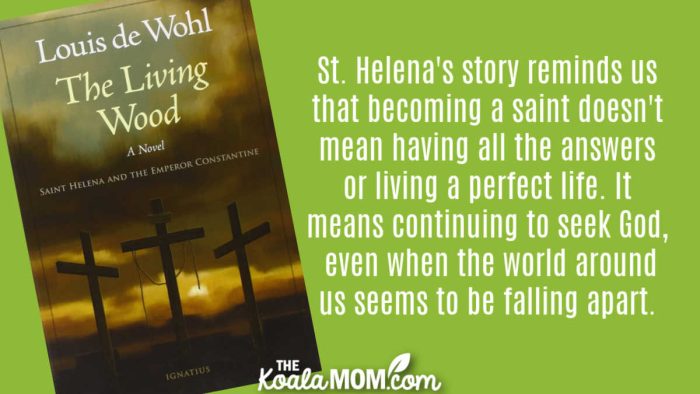
I enjoyed The Living Wood because it presents St. Helena as more than the mother of Constantine or the woman who discovered the True Cross. She is a woman who experiences love, loss, anger, doubt, and disappointment, yet continues to grow in faith. Her story reminds us that becoming a saint doesn’t mean having all the answers or living a perfect life. It means continuing to seek God, even when the world around us seems to be falling apart.
As a mother, I especially appreciated the reminder that we cannot make our children into saints by sheer force of will. We can teach them, pray for them, and try to set a good example, but ultimately, each of them must choose their own path. That can be a difficult lesson to learn, particularly when we long to see our children grow in faith.
If you enjoy historical fiction that brings the saints to life as real people, with all their strengths and weaknesses, I recommend The Living Wood. Helena’s story offers both an engaging glimpse into the early Church and a timeless reminder to persevere in faith, trusting that God is at work even when we cannot yet see the fruits of our efforts.
Check out my book club picks for more books like this!
No Responses Yet