


I wanted to like The Marriage Gap. The premise sounded promising: a Catholic husband and wife having honest conversations about the different needs spouses bring to marriage and encouraging couples to listen to each other, ask deeper questions, and rediscover the person they married. After years of reading marriage books—both Catholic and evangelical—and reflecting on what helped and didn’t help me in my own first marriage, I’m always interested in resources that encourage couples to communicate better and understand each other more deeply.
Unfortunately, while I agree with much of what Devin and Kim Schadt say about the importance of communication, I found the book deeply problematic. It repeatedly relies on stale gender stereotypes, presents complementarian ideas that don’t fit well with Catholic teaching, and, most concerningly, fails to distinguish between ordinary marital struggles and abuse. There are some good ideas here, but I ultimately wouldn’t recommend The Marriage Gap to couples looking for a healthy, evidence-based guide to marriage.
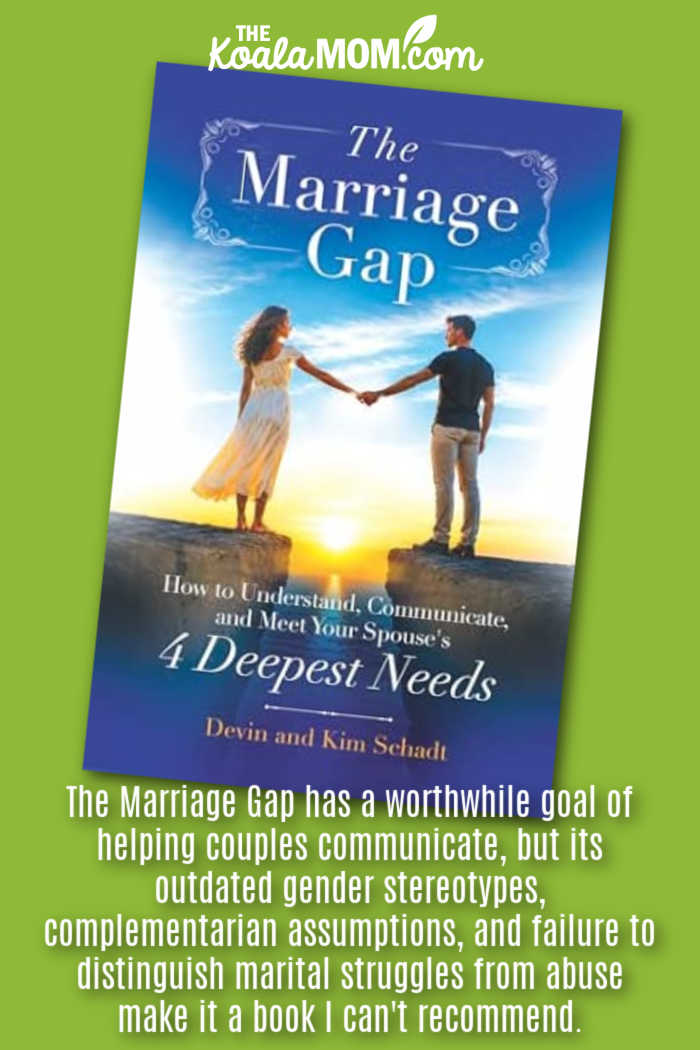
I received this book for review courtesy of the publisher; all opinions expressed remain my own. This post contains affiliate links; as an Amazon associate, I earn from qualifying purchases.
What This Book Gets Right
Throughout The Marriage Gap, Devin and Kim Schadt encourage married couples to talk and communicate better. The book itself is written in the form of conversations between them about the topics they present, although I don’t think their intention of providing an “example” of conversations quite works. Most spouses aren’t “teaching” each other the way Devin and Kim do in this book.
They open The Marriage Gap by saying:
The purpose of this book is not so much to teach married couples how to have a great marriage but rather to give married couples a way to learn about themselves and their spouse, which is at the heart of a great marriage. The book is intentionally designed to help spouses enter into their spouse’s worldview and understand things from their perspective, with the ultimate purpose of re-discovering their spouse.
I heartily agree with what Devin and Kim want to do here. I don’t agree this book helps couples do that.
One thing I do appreciate is their recommendation that couples read one section at a time and then discuss it together. That’s a great way to tackle almost any marriage book. Rather than simply reading through a list of advice and moving on, you’re actually stopping to think about how those ideas apply to your own relationship. My partner and I have done this with two books by John and Julie Gottman. In fact, we even spent part of the drive home from a ski trip reading one book aloud and talking about it together. That kind of shared discussion can turn a marriage book from something you simply read into something you actually apply to your relationship.
Devin and Kim explain, “The purpose of this is not only to learn about and discover your spouse anew, but also to learn about yourself and what you really need.” Later, they add, “Don’t assume that you know what your spouse needs. Ask those deeper questions about your spouse’s desire.”
I really like this attitude of curiosity toward both ourselves and our spouses. It’s easy to assume that after you’ve been married for a while, you know everything there is to know about your spouse. But people change over time. Our circumstances change, our priorities change, and sometimes our needs change, too.
The Gottmans talk about making “love maps” of our spouses and updating those on a regular basis. In other words, we need to keep learning about the person we’re married to rather than assuming that the person we knew five or ten years ago is exactly the same person sitting across the dinner table today. This is something that my partner and I often do, and I think it can be a really valuable habit in a marriage.
The Schadts also address another common problem: assuming that our spouse “has the same wants, desires and needs” that we do. When we assume that our spouse will think, feel, or respond the way we would, we’re bound to end up frustrated when they don’t. They compare this frustration to a weed:
Smoothing it over is like cutting off the weed at the ground level. When we cut a weed off without rooting it out, the weed simply grows back stronger and larger and gives birth to other weeds. Either by placating the frustration or ignoring it, eventually the garden of marriage, which is supposed to produce incredible fruit and beauty, becomes overrun with the weeds of frustration and bitter resentment.
There is some real wisdom here. Small frustrations that aren’t addressed can pile up, especially when we don’t understand what is actually causing them. We can ignore the problem, try to keep the peace, or assume that our spouse should simply understand why we’re upset. None of those approaches is particularly helpful in the long run.
In my current relationship, more than once, even though it’s difficult for both of us because of our past unhappy relationships, either my partner or I have had to bring up a “weed” with the other. It’s not always easy to say, “Hey, there’s something bothering me that we need to talk about.” But once we’ve talked about it, we’re always grateful that we didn’t just let it go—that we actually took the time to pull the weed out instead of letting it stay there.
We both know first-hand that not addressing these weeds can lead to disconnection and problems in marriage—the “marriage gap” of the title. The solution, according to the Schadts, is to know each other as God intended in marriage. Couples need to overcome their assumptions about each other, work at learning what they don’t know about their spouse, and come to know and trust one another intimately.
And to do that, couples need to learn to communicate—not just to talk to each other, but to talk and to listen. Too often, we assume communication just involves one person saying something to another person (and often we’re given advice on how to say things). Listening is just as important as the talking, however. If one spouse isn’t listening to the other spouse, then it doesn’t matter what that spouse is saying.
This leads into the main topic of the book: communicating our needs to our spouse. The Schadts say, “God designed marriage to be a relationship where the couple identifies each other’s needs, and by knowing this, they become capable of addressing those needs, whereby they become self-giving.”
This is indeed one of the beautiful things about marriage: being able to be vulnerable and needy with someone who loves us as we are and is willing to help meet our needs. As the Schadts add, “To communicate your needs to your spouse necessitates that you know your own needs and that you are willing to expose them to your spouse.”
I agree with that, too. If you don’t know yourself, you can’t really share yourself with your spouse. So The Marriage Gap attempts to help couples understand themselves and their own needs, and then communicate those needs to their spouse in order to strengthen their relationship. That’s a great and lofty goal. Unfortunately, I don’t think the Schadts succeed in doing it. Here’s why.
1. The Marriage Gap Normalizes Abuse
I want to consider, for a moment, the reader of a book like this. An article in Psychology Today estimates that about three-quarters of self-help books about relationships are bought by women. The author notes, “Agents and publishers know that when there is a relationship problem or issue, it is often the woman who blames herself. The billion-dollar self-help industry, in many cases, essentially presents women as flawed, and responsible for fixing themselves. These books are offering a solution to the so-called ‘flawed’ woman.”
So while The Marriage Gap is written by a couple (with the husband known for his previous books) and formulated as a conversation between the spouses, the likely reader is a woman. Is that woman in a healthy relationship or an unhealthy one? The Marriage Gap is written for someone who has noticed there is a “gap” between her and her spouse. Something isn’t working in her relationship, and she wants to fix it.
This is where too many relationship books, including this one, can cause harm. They assume the problem is something both spouses can work on together, while failing to address one significant cause of marital problems: abuse. In fact, The Marriage Gap doesn’t just overlook abuse; at times, it normalizes it. Abuse actually comes up quite frequently in the Schadts’ conversation, but it is rarely identified as abuse or properly called out as a big problem.
In the introduction, they acknowledge that the kinds of conversations they are suggesting can cause painful things to surface: “We realize that your deepest longings are difficult to express; and it might be painful for you that they have not been address by your spouse. Don’t run from the pain. The pain indicates both desire and disappointment.”
It could also indicate abuse. Your needs may not have been met by your spouse in the past because your spouse is deliberately choosing not to meet them. Sharing those needs now could open you up to further abuse, because now your spouse knows better what you need—and can continue to withhold it, manipulate you, or use that knowledge against you.
This section desperately needs a disclaimer. At the very least, the authors should distinguish between a marriage in which spouses are struggling to understand and meet each other’s needs and a marriage in which one spouse is deliberately harming or controlling the other. A woman who suspects she is in an abusive relationship needs very different advice from a woman whose husband simply doesn’t understand what she needs.
The Schadts go on to say:
Our experience is that, though it is difficult and challenging to navigate such delicate topics, if the spouses sincerely desire to love one another and create an intimate, joy-filled marriage, often they will arrive at the sacred place of asking for, receiving, and giving forgiveness.
That’s a really big if. Unfortunately, I know too many spouses who did not sincerely desire to love their spouse. The Schadts say, “Often spouses are not maliciously or intentionally neglecting one another.” But sometimes they are, and that distinction matters enormously.
Without acknowledging it, this advice can leave a woman believing that she simply needs to keep trying: communicate her needs better, listen more carefully, understand her husband’s perspective, meet his needs, and work harder at creating intimacy. Perhaps, if she does all those things, her husband will eventually respond in kind and they will arrive at the kind of marriage the Schadts describe. But what if he doesn’t want to?
What if the problem isn’t that he doesn’t understand her needs? What if he understands them perfectly well and simply doesn’t care? What if withholding those needs is part of the control? What if asking her to keep being vulnerable with him actually gives him more information that he can use against her?
Those possibilities need to be addressed in a book telling women how to repair the “gap” in their marriages. Otherwise, advice about communication, forgiveness, and understanding can inadvertently keep women in abusive relationships by encouraging them to keep working on a relationship that cannot be repaired by one person.
The lack of awareness around abuse in The Marriage Gap is particularly concerning because Kim has first-hand experience with it. Abuse comes up early in the book when they discuss a woman’s need for love. Kim says:
I’ll begin by sharing my worse memory of my dad. I was a little girl, mowing the lawn. In my peripheral vision I saw my mom running across the yard. I realized that dad was chasing after her. Initially, I thought they were joking around. But then dad caught her, threw her to the ground, and began to hit her repeatedly.
Devin asks her why this moment was so terrifying, and she answers: “Dad was supposed to love my mom… it was his duty to protect her. But rather than protecting her, he was assaulting her.” She goes on to describe how she felt in that moment, and later shares a memory of her dad touching her knee while he was in the car with her. She says: “Dad was unpredictable. He was abusive physically and emotionally. At that moment, he may have been trying to be affectionate, but because of his abusiveness, I could not trust him.”
Kim clearly recognizes her father was abusive. She understands that his physical and emotional abuse made it impossible for her to trust him, even when he was doing something that might otherwise have been affectionate. And yet, on the very next page, she describes her parents’ marriage as “unstable” and “schizophrenic,” while also saying that her parents were “affectionate” and that “closeness, attention and affection were evident” between them. That’s where I struggle with the book’s treatment of abuse.
Her father’s actions were serious enough that Kim can now name them as abuse. But The Marriage Gap doesn’t seem to explore what that abuse meant for her mother’s marriage, what healthy boundaries might have looked like, or what the appropriate response to an abusive spouse should be. There is no meaningful discussion of safety, separation, accountability, or the fact that abuse fundamentally changes the advice we should give someone about communicating their needs and becoming more vulnerable with their spouse.
Instead, the abusive relationship becomes an example in a conversation about the need for love and intimacy. That is a significant problem for me. If the authors are going to tell readers to uncover their deepest needs, become vulnerable, forgive their spouses, and work toward greater intimacy, they also need to tell readers when not to do those things with an unsafe person.
A difficult marriage and an abusive marriage are not the same thing. One may need better communication. The other may need safety, boundaries, outside support, and accountability. A book about closing the “marriage gap” needs to know the difference.
There are other places in The Marriage Gap where Devin and Kim describe dynamics in a marriage that are abusive without calling them out as such. For example, after talking about her parents’ relationship, Kim makes a list of six things that “men do that make their wives feel insecure in their love.” One of those items might call for a conversation between the spouses, but I would say that if a husband is guilty of half or more of the things on this list, there are much more serious problems in the relationship than simply needing to communicate better.
Two of the items describe forms of neglect, and at least one should be flagged as possible abuse. Yet the authors don’t stop to distinguish between ordinary marital shortcomings, neglect, and abusive behaviour. Instead, they simply present these as “things the husband should stop doing if he wants to love his wife.”
That’s a troubling distinction to leave out. A husband who doesn’t notice his wife’s efforts to lose weight may need to be more attentive. A husband who cannot “control his emotions and restrain his anger” is a different problem. And a husband whose behaviour is abusive needs to be held accountable for that abuse—not simply be encouraged to try harder at loving his wife. By putting all of these behaviours into the same category of things a husband should “stop doing,” The Marriage Gap misses an important opportunity to help women recognize when they are dealing with something much more serious than a communication problem.
2. The Marriage Gap Repeats Stale Evangelical Marriage Advice
I joined the Catholic Church when I married my first husband in my early twenties. Since my divorce, I’ve spent a lot of time looking back at my childhood and my marriage and thinking about what led to my divorce. One of the things I’ve questioned is the advice I received as a married woman and whether that advice actually helped me—because I read a lot of marriage books.
Although I was Catholic, I continued to read evangelical authors I’d known before my conversion. One of the authors and influencers I’ve followed for nearly two decades is Sheila Wray Gregoire. A decade ago, Sheila’s advice to married women was fairly similar to what many other evangelical marriage authors were saying. Over the last decade, however, her work has pivoted significantly as she’s examined the harm that bad marriage advice can cause. Her work is now focused on offering healthy, evidence-based marriage and sex advice, as well as highlighting the problems with unhealthy advice.
Coming from that background—years of reading evangelical marriage advice and then reading Sheila’s critiques of many of the big-name authors—I was surprised by how familiar so much of The Marriage Gap felt. The ideas presented here aren’t new, although they may be new to some Catholic readers. Love and respect, complementarianism, spiritual headship, and the idea that men have a particular need for sex are all old evangelical ideas. They are also ideas that Sheila and others have spent years challenging because of the harm they can cause.
Men and women in stereotypical boxes
The entire premise of The Marriage Gap is that men and women have different but complementary needs. We’ve heard this before: men are wild at heart, women are captivating, men are from Mars, women are from Venus, men are like waffles and women are like spaghetti. In Christian circles, this is generally connected to complementarianism, the theological view that men and women are equal in value and dignity but were created by God for distinct, complementary roles in marriage, the family, and the church.
Many people within evangelical circles are now speaking out against complementarianism, including Sheila. As Rachel Held Evans said, “Complementarianism isn’t working—in marriages and in church leadership—because it’s not actually complementarianism; it’s patriarchy. And patriarchy doesn’t work because God created both men and women to reflect God’s character and God’s sovereignty over creation, as equal partners with equal value.”
For a long time, I’ve been grateful that this particular framework isn’t pervasive in the Catholic Church. There are a lot of amazing saints of both genders who don’t fit into our stereotypical gender norms. But apparently, Devin and Kim are trying to change that.
My biggest problem with all four sections of The Marriage Gap is that it puts men and women into stereotypical boxes. At this point in my life, stereotypes are a red flag for me because stereotypes usually stop questions—and often stop the very discussions that Kim and Devin say they want to encourage in this book. Stereotypes also don’t fit everyone, which can cause a lot of pain and misunderstanding.
Take their first example: love and respect. The Schadts claim that men want to be respected and women want to be loved. Well, I want both. I want to be loved and respected, and so does my partner. That’s also what I’ve heard from other people I’ve talked to. Why assume that one is primarily a male need and the other primarily a female need? If the purpose of this book is to help spouses discover their individual needs, putting those needs into gendered categories from the beginning seems to undermine that purpose.
Love and Respect all over again
In a book about complementary needs, I wasn’t surprised to find a discussion of love and respect. I was surprised that the Schadts made no mention of Emerson Eggerichs, who literally wrote the book Love and Respect more than twenty years ago (not to mention the conferences and ministry built around it).
They do mention Shaunti Feldhahn’s For Women Only, which raised huge red flags for me. Sheila has done a deep dive into Shaunti’s books, including the “poor research practices, using very badly worded survey questions that do not pass academic rigor” behind the books. She calls For Women Only the third worst evangelical sex and marriage book, behind Every Man’s Battle and Love and Respect. Sheila and her team have also done a deep dive into Love and Respect, looking at problems with Eggerichs, his faulty research, his misuse of Scripture, and the fruit of the book.
Given that history, I found it frustrating to see these same basic ideas repackaged in The Marriage Gap without any engagement with the substantial criticism of them.
There is also an odd contradiction within the book itself. While Devin and Kim claim that men need respect, Kim repeatedly says that she wants respect, too. In the section on her need to be loved, Kim quotes one woman who says she wants “Respect for who I am–beyond wife and mother” and another who says, “I need to feel protected, cherished, respected.”
Then, in the section on her need for closeness, Kim says, “The next most common complaint that a man does that causes drift is to fail to respect her.” Devin then asks, “What does ‘being respected’ look like to you?” and Kim provides a list. So, wait. Both men and women need respect? Apparently, this isn’t just his need after all.
“I need his strength; he needs my beauty”?
Some of the gender stereotypes in this book were so foreign to my experience that my partner and I actually laughed at them. When I told him that The Marriage Gap says I need his strength and he needs my beauty, he nearly spit out his sandwich and shouted, “What the —-?” Yeah. Pretty much my reaction.
I grew up with two brothers and my dad. If I needed something heavy moved or my vehicle fixed, I called them. I did that because I could—they were around. It was also the gendered stereotype I grew up with: guys did the heavy, dirty work and girls didn’t. The thing was, I didn’t need them to do those things.
After my divorce, when I lived in a tear-down that needed a lot of repairs, my brother sent me a box of tools. I was so proud of my drill. I fixed my toilet. I fixed my leaking kitchen sink. I hammered trim on the staircase, screwed bookcases to walls, and changed electrical fixtures. Now, it’s nice when my partner is around to help me move something heavy, like the bike rack. However, if he’s not around, I do it myself.
While he calls me beautiful and regularly compliments me, he also loves me for my sense of adventure, my problem-solving skills, and a whole lot of other things. To both of us, reducing our needs to “his strength” and “her beauty” feels incredibly shallow.
Men need sex?
The Schadts next claim that women need “his closeness” and men need physical intimacy. The idea that men need sex has been around evangelical circles for a very long time. James Dobson (cited in one footnote) famously claimed that men need sex every three days, although there is no research to back that up. (His work is now also being thoroughly criticized by people who were harmed by his teachings on marriage and parenting.)
Sheila Gregoire’s book The Great Sex Rescue challenged many traditional Christian messages about sex and marriage, particularly by affirming that women’s sexual pleasure matters too. Drawing on research including a survey of 22,000 Christian women, Gregoire explores how harmful beliefs about sex can damage women, men, and marriages.
My biggest problem with the Schadts’ section, however, is once again the contradiction between their gendered framework and what they themselves quote. A lot of this section felt very icky to me—not because I don’t like discussing this topic (my partner and I talk about it freely), but because Devin’s take on it felt so stereotypical of ideas that have circulated both in mainstream culture and in evangelical culture.
And then, early in the section, he includes a beautiful quote from Pope St. John Paul II:
Marital continence is so much more difficult than continence outside marriage because the spouses grow accustomed to intercourse, as befits the state which they have both consciously chosen. Once they begin to have sexual intercourse as a habit, and a constant inclination is created, a mutual need for intercourse comes into being.
Devin uses this quotation to justify his need for sex, highlighting the word “need” while seemingly overlooking the word mutual that comes immediately before it. John Paul II doesn’t say men need sex. He says spouses need sex. They develop a mutual need. That’s a significant difference.
This is where the book’s attempt to present evangelical complementarian ideas as Catholic marriage teaching falls apart. The Catholic understanding of marriage is not simply “men have these needs and women have those needs.” The spouses are called to mutual self-gift. Sex is for both spouses.
Spiritual leadership
The final section is on her need for his spiritual leadership and his need for “her partnership in the mission.” Again, I found myself wondering whether the authors were presenting an evangelical understanding of marriage as though it were simply Catholic teaching. One of the women surveyed for this book had this thought too and tells them:
I do want to gently remind us that the Catholic Church teaches that husbands and wives lead with mutuality. While we are not the same, we are called to lead together as husband and wife. While wives and husbands aren’t interchangeable, the idea that the husband is the only one called to lead isn’t Catholic…
Following this quote, Devin says: “They both have the authority that God endowed them with. They are, as a couple, to lead together. Yet, that authority begins with the husband and is initiated by the husband.” No. He’s contradicting both himself and the woman he just quoted. And, more importantly, I don’t think this is a fair representation of Catholic teaching on marriage.
The Catholic Church has many examples of amazing female saints who were also leaders. St. Margaret of Scotland, for example, was a spiritual influence in her home, teaching her husband, King Malcolm III, about their faith and leading by her own example. And interestingly, Kim herself says on the next page that one quality of a leader is that “He is the head but learns to love from the heart–specifically, he learns from his wife.”
Even later, she says that while the husband is to lead his family in prayer, “Perhaps his wife can prompt or remind him.” But if she is the one prompting, reminding, teaching, encouraging, and sometimes even initiating the family’s spiritual life, why are we still insisting that she isn’t leading?
When “spiritual leadership” is really just another job
Much of this section seemed to me to be coming from unexamined wounds and assumptions rather than healthy, evidence-based advice. What a woman in an abusive, disappointing, or toxic relationship needs is very different from what a woman in a healthy, loving relationship needs. And what a particular husband and wife need may be very different from what another couple needs.
The Schadts quote one woman who says that she wants her husband to “initiate family prayer” because “Moms spend so much time on logistics and practical matters, sometimes it’s nice to have dad take over.” That’s not necessarily a woman asking for a spiritual leader. That’s a woman who sounds exhausted.
She’s doing all the things. She’s carrying the mental load of the family. And she just wants him to help with something—anything—so perhaps she finds something that seems “manly” to give him. Or maybe she chooses something that seems less important because if he forgets family prayer, no big deal, but if he forgets to pick up a kid or cook dinner, then there’s trouble. Maybe what she actually needs isn’t for her husband to be the spiritual leader. Maybe she needs a partner.
3. What Are the Sources?
My final problem with this book is its sources. While more than half of the footnotes reference Catholic sources, including the Catechism and the works of Pope Saint John Paul II, the Schadts also cite James Dobson, Shaunti Feldhahn, Gary Chapman, and John Eldredge—all authors whose credentials, research, or advice have been questioned. Dobson, Feldhahn, and Eldredge in particular have helped popularize the tendency to put men and women into stereotypical boxes, which is a significant feature of The Marriage Gap.
The Schadts’ other major “source” for this book is a “survey” they conducted. Unfortunately, they don’t tell us much about it. They don’t say how many people they surveyed, how the survey was conducted, what the questions were, or how they analyzed the responses.
Was this simply an informal poll of their friends, like the kind of polling I sometimes do in my own social media groups to get a sense of how people respond to a question? Or was it a carefully designed survey using sound research practices? Were the questions framed as false dichotomies, as I’ve seen criticized in some of Shaunti Feldhahn’s research, or were they open-ended questions designed to discover what people actually think and need? How many people participated? How were they selected? How were the answers interpreted?
I don’t know—and that’s the problem. I’m not saying that every book needs to contain a peer-reviewed academic study. But if you’re going to use your own survey as evidence for broad claims about what men and women need from marriage, readers deserve enough information to evaluate that evidence.
Sheila Wray Gregoire has also based her books on surveys, but there’s a significant difference. Her research has involved tens of thousands of women and has been conducted with considerably more transparency and methodological rigor. Whatever conclusions you ultimately draw from her work, you can actually examine how she got there. In The Marriage Gap, we’re repeatedly told what men and women supposedly need, but we’re given very little information about how the authors arrived at those conclusions. Given how heavily the book relies on gendered assumptions, I think that’s a pretty significant omission.
Final Thoughts
I could give you many more examples of the problems I found in The Marriage Gap. There are more contradictions, more stereotypes, and more places where the authors present questionable evangelical marriage advice as though it were simply what Catholic marriage is supposed to look like. But at some point, a book review has to stop, and I think I’ve made my point.
The frustrating thing is that I don’t disagree with the goal of this book. I absolutely believe that married couples need to communicate, listen to each other, understand their spouse’s perspective, discover how their needs have changed, and keep getting to know each other. I think those are important parts of a healthy marriage. I just don’t think The Marriage Gap is the book I’d recommend to help couples do those things.
If you’re looking for a marriage book, I’d suggest starting somewhere else. Sheila Gregoire’s work is a much better resource if you want to understand how unhealthy Christian marriage and sex advice can harm couples—and what healthier, evidence-based advice can look like. Her books, including The Great Sex Rescue, are particularly valuable for women who have spent years hearing that their husband’s needs should take priority over their own.
And if you’re looking for practical tools to improve communication and understand your spouse better, I’d recommend John and Julie Gottman’s books, especially The Seven Principles for Making Marriage Work. Their work on love maps, friendship, communication, conflict, and the habits that help couples stay connected has been much more useful to me personally. As I mentioned earlier, my partner and I have actually worked through their books together, and their books don’t put us into boxes based on our gender.
The Marriage Gap wants to help couples rediscover each other. I think that’s a worthwhile goal. I just wish it had done so without relying so heavily on outdated gender stereotypes and complementarian assumptions, and without overlooking the crucial distinction between a marriage that needs better communication and a marriage in which one spouse is being harmed.
There are better resources out there. I’d encourage you to read those instead.
No Responses Yet