


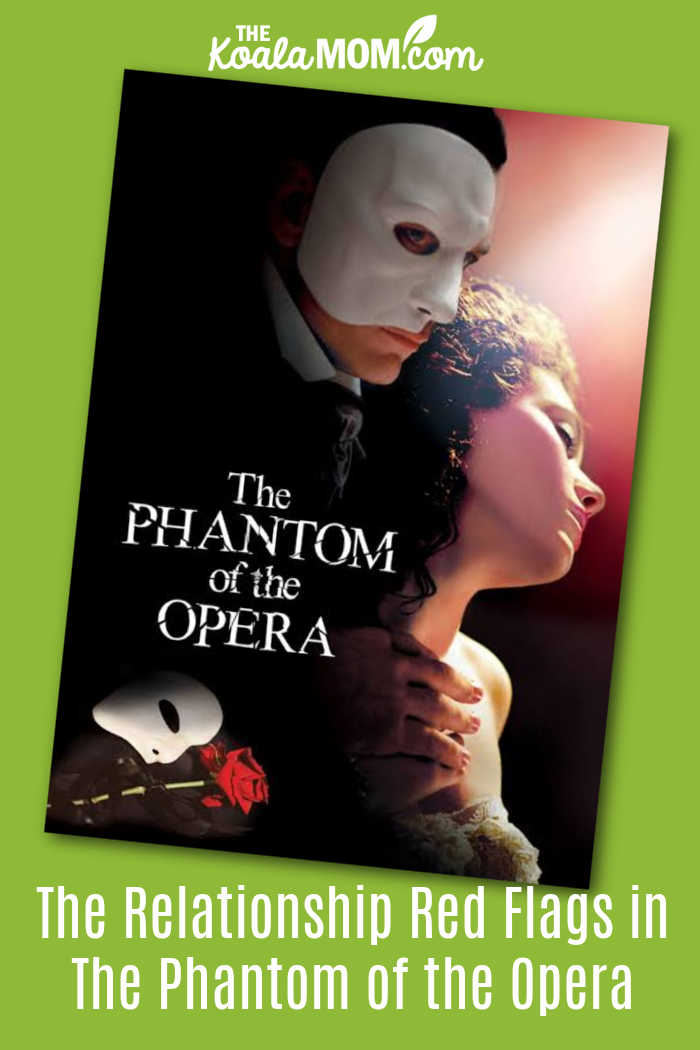
When I first saw Phantom of the Opera in theatre as a university student, I was carried away by the soaring music and tragic love triangle. I had a much different take on the movie when I watched it more recently with my teenagers.
The music was still magnificent and moving (despite Gerrard Butler’s inability to hit certain notes), but the love stories raised red flags for me. While the Phantom’s abuse is obvious, Raoul’s flaws are easier to overlook. Although he is unquestionably the healthier of the two, he repeatedly dismisses Christine’s concerns and assumes he knows what’s best for her. Neither relationship offers Christine the mutual respect and partnership she deserves.
This post contains affiliate links; as an Amazon associate, I earn from qualifying purchases.
Let’s Look at Christine
Christine (played by Emmy Rossum) is as an orphan who lost her father when she was 7 years old and has been raised in the opera dormitories by Madame Giry, alongside Giry’s daughter Meg. She is an exceptionally talented singer who has been trained by the Phantom, whom she has never seen and thinks is the angel her father promised to send her on his deathbed. Various calamities orchestrated by the Phantom allow Christine to become a star on stage, but the Phantom’s jealousy is triggered when she is reunited with her childhood friend, Raoul.
Christine often appears passive, which frustrated me every time I’ve watched this film. She reminds me of Buttercup in The Princess Bride: a helpless heroine who simply lets events happen around her. For Christine, that passivity does make some sense. She has spent years being manipulated by the Phantom, isolated, and taught to obey the mysterious “Angel of Music.” Raised within the opera from childhood, Christine has had little opportunity to develop an identity outside the roles others have chosen for her. Her talent has been cultivated, but her independence has not.
As Luminous Editing points out, Christine’s passivity is reinforced throughout the film by the way she seems to mirror the expectations of the people around her. In her first scenes with the Phantom, she follows him without protest into his underground lair, takes his hand, and allows him to direct nearly every movement. Later, when she escapes to the rooftop with Raoul, she initially focuses on him, but as soon as she hears the Phantom’s voice calling to her, she drifts toward him in a trance-like state until Raoul physically redirects her attention.
Rather than voicing her own desires or making independent decisions, Christine often seems to reflect whichever man is demanding her attention at the moment. The result is that she feels less like the protagonist of her own story and more like the object for which two men are competing.
The Phantom: Pure Evil
The Phantom of the Opera (played by Gerard Butler, to some controversy) reminded me in some ways of Healthcliff from Wuthering Heights. He was abandoned and mistreated as a child, spurned because of his grotesque physical appearance, as he tells Christine: “Hounded out by everyone! Met with hatred everywhere! No kind word from anyone! No compassion anywhere! Christine! Why? Why?”
Like Christine, he has grown up in the opera house — but in its bowels and depths, instead of its comfortable dormitories. Madame Giry explains that he is a genius of music, and writes operas, so his hiding place has enabled him to thrive in a way, while also driving his unhealthy fantasies.
One of the greatest tragedies of this story that the Phantom shouldn’t have had to hide. I couldn’t help wondering whether the opera house—with its actors, masks, elaborate costumes, and larger-than-life personalities—might have offered him more opportunities for belonging than the isolation he ultimately chose. Perhaps a French opera house in 1880 is not quite the inclusive circus of The Greatest Showman, despite the one actor with dwarfism shown on stage.
The red flags in the Phantom’s relationship with Christine are obvious. He’s much older than her, doesn’t have any family or friends, attempts to control all her movements and relationships, and is obsessed with her and her voice. He plays on Christine’s naivety and grief for her father to manipulate her into the star he wants her to be. While Christine at first sees him with admiration, that soon turns to pity, and then to a recognition of the danger he poses.
The Phantom’s tragic childhood explains how he became the man he is, but it does not excuse what he does. As FanCornerCreations writes, “Phantom isn’t morally gray. He’s pure evil. No tragic backstory changes the murders, kidnapping, emotional abuse, and threats.” I agree with the underlying point: understanding the Phantom’s suffering should never lead us to romanticize or excuse his abuse of Christine.
FanCornerCreations also points out that Raoul is “her useless admirer… who still thinks he knows better than her.” While I wouldn’t go quite that far, I do think the movie asks us to overlook some troubling patterns in Raoul’s behavior simply because he is contrasted with someone so much worse. Yet healthy relationships aren’t measured against abusive ones—they should be evaluated on their own merits. Let’s take a closer look at Raoul.
Raoul: Hero or Abuser?
The Vicomte de Chagny, also known as Raoul (played by Patrick Wilson), enters the scene as the newest patron of the opera and is recognized by Christine as her childhood best friend. In their touching reunion, Raoul sings to Christine about being playmates together in happier, more innocent times. He is young, handsome, rich, with little backstory, and he wants to sweep Christine off her feet.
The biggest red flag is that Raoul repeatedly refuses to listen to Christine. In their first meeting, he tells her she should come out with him to celebrate her recent success. Christine tries to refuse, saying something about the Phantom, but Raoul completely ignores her, laughing as he insists upon his way, and leaves her alone. The Phantom appears to Christine for the first time, angry at Raoul’s attempts to be part of Christine’s triumph. While Madame Giry sees this, she doesn’t intervene (raising other red flags about enablers of abuse).
At the masquerade ball some months later, Raoul and Christine discuss their secret engagement but, as FanCornerCreations points out, “Raoul is dismissive of Christine’s panic to make it public knowledge. He still doesn’t take her seriously. The murder, poisoning, notes, and fallen chandelier aren’t enough for Raoul.” Despite all the proof on Christine’s side about the dangers of the Phantom, nobody is willing to listen to her.
When Raoul comes up with his plot to catch the Phantom, Christine begs him not to make her do this. She recognizes the danger he’s putting her into, but he brushes this off, saying he’ll be right there. Because this is a movie, Christine and Raoul get their happily ever after together — but Christine’s concerns in that moment were completely true. The Phantom shows up on stage with Christine, when Raoul is far away and unable to protect her, and Raoul’s refusal to listen to Christine could have led to both their deaths.
After Raoul’s refusal to listen to Christine’s fears about the Phantom so many times, Christine’s decision not to wake Raoul to tell him she’s going to the cemetery becomes more understandable. She’s scared of the Phantom, but no one will believe her, so she turns to the only person who listened to her — her father, even though he’s now dead. She is, in many ways, a lost child seeking guidance, a lost child who never had a chance to grow up and find mature independence.
None of this makes Raoul equivalent to the Phantom. The Phantom manipulates, kidnaps, threatens, and murders people. Raoul seems to genuinely love Christine and repeatedly risks his own life to save her. But healthy relationships require more than good intentions. Again and again, Raoul assumes he knows better than Christine, even when she’s the only person who truly understands the danger they’re facing.
To Guide Christine
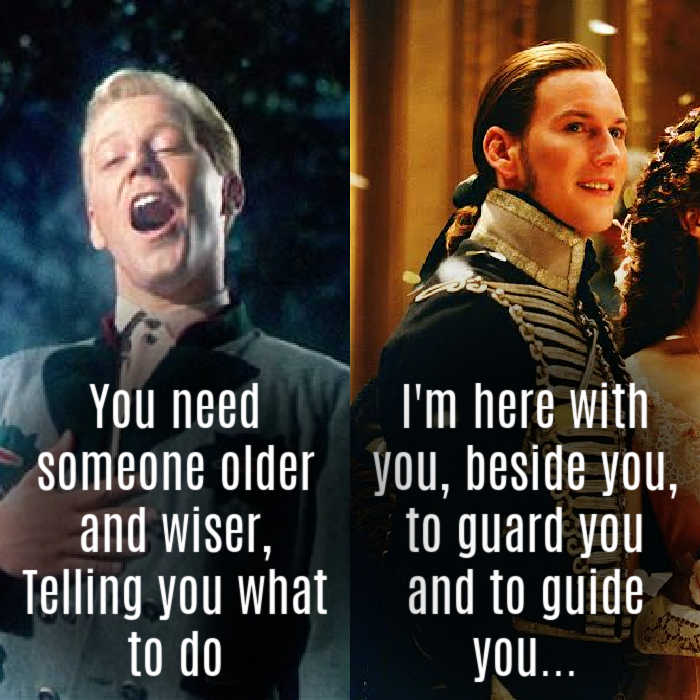
Licensed therapist Jonathan Decker and professional filmmaker Alan Seawright of Cinema Therapy contrast the two loves songs in the movie, showing that the Phantom’s love song is one sided and full of lust, while Raoul’s love song is a duet with Christine that focuses on a mutual relationship. However, Decker and Seawright miss one concerning line in that duet: “I’m here with you, beside you, / to guard you and to guide you…” (emphasis mine).
In isolation, “guard you and guide you” could simply sound protective. But viewed alongside Raoul’s repeated refusal to listen to Christine, the lyric takes on a more paternalistic tone. Interestingly, both the Phantom and Raoul use similar language in talking to Christine. Raoul promises to “guard you and guide you,” while the Phantom calls Christine a “wandering child… yearning for my guidance.” Although their motivations are very different, both men cast themselves as the one who knows better.
That line had echoes for me of Rolf in The Sound of Music, telling another naive young woman, “You need someone older and wiser / Telling you what to do / I am seventeen going on eighteen / I’ll take care of you.” The blatant sexism and romanticized misogyny in these lyrics is now getting called out, along with Rolf’s patronizing condescension of Liesl (who is only a year younger than he is), the manipulation in his offer to “guide you,” and the dated views of marriage as causing a woman to belong to a man.
Neither Christine nor Liesl need a man to guide them; they need a man to see them for who they are, accept them, support them, and listen to them. Good, healthy relationships are built on honest and open conversations, mutual respect, and a willingness to seek each other’s opinions and ideas.
Raoul and Christine should be equals who take turns guiding their relationship. For example, on the topic of the Phantom and the opera house, Christine is the expert. Raoul should recognize this and be willing to listen to her and do what she says, instead of brushing her off as being a “silly young girl” who doesn’t know anything.
Perhaps that’s what frustrated me most on this rewatch. The story asks us to choose between obsessive control and well-intentioned paternalism, as though those are the only two options in men and romance. The Phantom’s manipulation is obvious, while Raoul’s is gentler and easier to romanticize. But Christine (and every woman) deserves something different altogether: a relationship built on listening, mutual trust, and genuine partnership. She doesn’t need a man to rescue or guide her nearly as much as she needs someone who believes her.
Happy Ever After… or Not
Although the Phantom and Raoul could hardly be more different in character, they have one thing in common: neither truly listens to Christine. The Phantom sees her as his angel and his musical masterpiece, while Raoul sees her as the childhood sweetheart he can rescue and protect. Both love an idealized version of Christine rather than the woman standing in front of them. Instead of asking what she wants or trusting what she says, they each assume they already know what is best for her. Christine becomes less of a partner with her own voice and more of a symbol—someone to possess, save, or guide.
The end of The Phantom of the Opera implies that Christine marries Raoul and lives happily ever after with him and their children. Yet, given Raoul’s repeated refusal to listen to her throughout the film, I can’t help but wonder whether, in marrying him, she’s simply exchanged one set of walls for another. The Phantom’s prison was built from fear and control; Raoul’s may be built from protection and good intentions. Either way, Christine still isn’t fully seen or heard.
A healthy relationship isn’t built on rescuing, possessing, or guiding another person. It’s built on listening. Christine deserved someone who trusted her voice as much as they admired it.
No Responses Yet