


When figuring out what kids need instead of screens, child development research points directly to structured physical challenge, unstructured outdoor play, hands-on creative making, productive boredom, collaborative imagination, independent reading, and direct connection with adults performing real tasks.
Most parents already recognize that excessive device use creates developmental friction, but replacing it requires practical alternatives rather than guilt. Providing these seven specific environments builds a comprehensive childhood routine where a tablet naturally becomes just one option among many.
Finding these alternatives matters because digital habits take up significant portions of the day. Recent data shows that 65.7% of boys and 64.6% of girls aged two to seventeen spend more than two hours of screen time per weekday, not counting schoolwork. Shifting this balance requires actionable substitutions.

1. Physical Risk and Challenge
Children possess a hardwired instinct to climb, jump, and test their physical limits. This functions as a vital developmental signal rather than a behavior problem to correct.
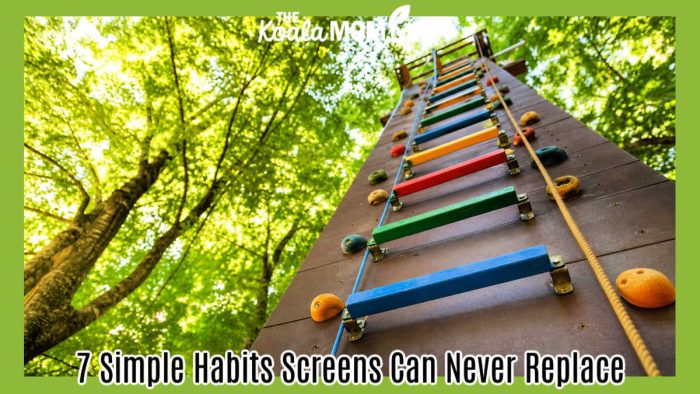
Committing to a physical challenge and succeeding builds proprioception, body awareness, and real-time risk assessment in ways that sitting still cannot replicate. Developing these skills requires environments with genuine structural variety instead of flat grass.
Among the options that consistently deliver this complexity, WillyGoat’s safe school playground equipment, a well-designed community park, and natural outdoor settings with uneven ground all provide necessary climbing progressions. For parents looking to keep their kids active, these engineered and natural spaces give children real physical decisions to make, such as pausing at a high rung and evaluating the distance before jumping.
| Key Insight: Committing to a physical challenge and succeeding builds proprioception, body awareness, and real-time risk assessment in ways that sitting perfectly still cannot replicate. |
2. Unstructured Outdoor Time
The most significant outdoor play benefits for kids emerge from time spent free of organized sports or adult coaching. Outdoor play encourages children to move and stay physically active, protecting their health in childhood and throughout life.
When children have open space, the varied sensory stimulation of natural textures and changing light measurably reduces physiological stress markers.
This habit requires an open-ended duration rather than an expensive location. An ordinary backyard, an empty school field, or a basic neighborhood park gives children the unscripted space necessary to invent games. They practice independent problem-solving when no adult steps in to organize the rules.
3. Making Something with Their Hands
Screens deliver passive consumption, while hands-on learning for children requires sustained effort that ultimately produces a holdable object. Building a tangible item develops fine motor skills and teaches the patience required to work through a process lacking an immediate digital reward.
Parents can introduce creative activities for kids through clay modeling kits, simple woodworking sets, and beginner fiber crafts. For children drawn to character and color, The Woobles’ whimsical crochet kits for beginners remove the frustrating early steps with pre-started pieces.
Guided video tutorials walk the child through each stitch independently, resulting in a completed plush dinosaur or penguin they can actually hold in their hands. Three of my girls love making little crochet critters for themselves and their friends.
Other ideas for hands-on learning include play dough and modeling clay, simple wood or plastic models, puzzles, craft kits, painting and sketching, sewing projects. Sometimes, it takes a bit of trial and error to find out what activities will interest your kids. For example, it was a babysitter who got my oldest hooked on crocheting, and then she passed that skill onto her younger sisters.
| Pro Tip: Start children with pre-started craft kits like The Woobles‘ crochet projects to bypass frustrating early steps, using guided video tutorials that lead to a completed plushie they can hold. |
4. Boredom and Its Benefits
Child development specialists recognize boredom as an essential incubation period for self-directed creativity. It functions as a necessary gap rather than a problem requiring an immediate technological solution.
Children who are not instantly rescued from a lull in activity consistently invent new games, imagine complex scenarios, and initiate their own physical projects.
The practical application involves resisting the reflex to hand over a tablet at the first complaint. Sitting with the temporary discomfort of silence allows the brain to shift gears. This restless energy typically resolves on its own into a genuinely interesting physical activity.

5. Collaborative Imaginative Play
The most productive screen-free activities for children require genuine partnership, such as building a living room fort or staging a dramatic scenario with neighborhood friends. This interaction forces children to navigate complex social layers simultaneously. They must negotiate whose rules apply and resolve immediate conflicts over narrative direction.
Digital devices tend to collapse collaboration into parallel consumption, where two kids simply watch the same video next to each other.
Imaginative pretend play demands active listening and real-time physical adaptation to keep the shared game moving forward. Kids learn to read facial expressions and adjust their tone to keep their peers engaged.
6. Reading for Pleasure
Independent reading operates differently from assigned school reading by prioritizing personal choice over comprehension testing.
Processing a fictional story requires a child to construct the visual world internally, building imagination and empathy in ways that high-quality video content bypasses. Reading for pleasure is positively associated with comprehension, grammar, and wider vocabulary over the long term.
Because the reader does the creative heavy lifting, the specific format matters far less than the physical engagement. Graphic novels, heavily illustrated series books, and familiar favorites all qualify. The only requirement is that the child actively chooses the material and returns to it voluntarily.
We like to visit our library on a regular basis, where the kids can browse the shelves for something that interests them. Often, I’ll grab a few books that I think they may like. Our library also has “grab bags” chosen by the librarians around a particular topic or age. My kids love picking up one of those bags, even if they only read two or three of the books inside.
7. Connection with Adults Doing Real Things
Children grow immensely through simple proximity to adult competence, whether they are watching a parent chop vegetables or tighten a loose cabinet hinge. This habit does not require a structured lesson or a formal demonstration. It simply needs an open invitation to stand nearby and help.
By watching an adult slowly work through a manual task, a child absorbs the realities of basic craftsmanship. Stirring pancake batter while a parent explains the recipe measurements provides a foundational understanding of sequence.

The Path Forward
Raising kids without screens as a primary crutch involves filling their days with enough compelling alternatives that a device naturally stops being the default answer. When a child’s routine already contains physical challenges on a playground apparatus and the satisfaction of building a beginner crochet project, digital entertainment becomes just one choice.
Adding productive boredom, imaginative collaboration, independent reading, and real human connection rounds out the daily developmental diet. Cultivating these seven habits represents a steady direction to move in, one specific activity at a time.
No Responses Yet