


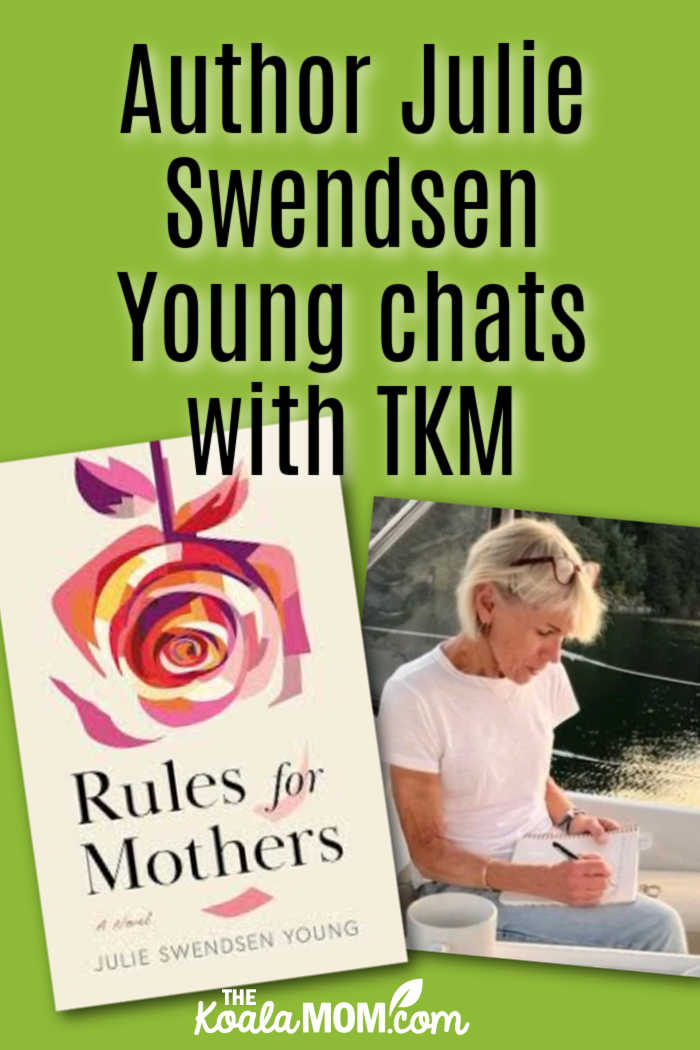
Since attending my first writer’s conference at age 16, I have enjoyed connecting with authors to discuss their books. One of the great perks of being a book reviewer is being able to ask authors questions about their books after reading. I thoroughly enjoyed Julie Swendsen Young’s novel Rules for Mothers and couldn’t wait to ask her some questions. Here, Julie shares more about why she wrote Rules for Mothers and what she does when she’s not writing.
This post contains affiliate links; as an Amazon associate, I earn from qualifying purchases.
TKM: Tell us a bit about yourself.
Julie Swendsen Young: I was raised on a subsistence farm in a sparsely populated county with few cultural resources. I was influenced from my earliest years by nature, a strong work ethic, and the values of education and integrity. My dad recited poetry he learned as a school boy, my mother was all about literacy, and the prairie was my playground.
That was then! I moved to the city as a young adult and quickly adapted. I was a clinical social worker who retired early and took up political advocacy. I’m a wife, a mom, a grandma, and a friend. My life is rich.
TKM: Where did the idea for Rules for Mothers come from?
Julie: You know how there are movies and novels about junctions and crossroads, the “what ifs?” My novel came from thinking about the choice I made, with my then-husband, to go back to work when our youngest child was three years old and our oldest was eight. I remember it being very exciting to buy an outfit for job interviews! The memory was and is poignant.
What does the memory mean? At the same time that I was reflecting on this, my daughter and two daughters-in-law with babies were making tough decisions about balancing careers and children. I wanted to write that story but make it fictional, which is really more fun that a drawn-out essay.
TKM: Which character in the book most resembles you (if any)?
Julie: I was much like Elly as a young mom, happy when my children were happy, discouraged when tired, and disconnected from women my age. I wasn’t, however, “frazzled” in the way I portray Elly. As a mature woman, I resemble Elly’s mother, who loves being a grandmother but enjoys her own pursuits, thank you very much.
TKM: Why did you pick this title?
Julie Swendsen Young: I had a working title, Divining, which I still like, but it could be misunderstood, e.g., theological. Rules for Mothers came to me as I was writing a scene where Elly acknowledges she would be breaking the rules if she gave custody of her children to their father. That is one rule, and the novel brings forward other cultural rules, that is, expectations for mothers.
Mothers arrange the play dates and school conferences, correspond with two sets of grandparents, shop for and prepare nutritious meals, do the bulk of the laundry, etc., etc. And now we’re reading about “mankeeping,” wherein women also carry the emotional weight of their partners. Elly likely did this for Dan.
TKM: Why do you think a sense of autonomy is so important for moms?
Julie: It’s important for everyone! Autonomy is critical for self-esteem, for us to know we have agency in our lives, that we are actors in our environment, not inanimate beings that things happen to. But to your question about why it’s important for moms, it’s because moms are more often than not their child’s model for how to act and how to behave.
Moms cue behaviors through actions, words, and moods. A burned-out mother who has lost her sense of purpose both subtly and directly communicates this to her children, risking their trust in mom to take care of them.
I’m not suggesting that mothers need a mission statement or a five-year plan. My point is that every mom – every human! – needs agency in her life. It’s her choice of what that looks like, but culture and society should not dictate what it is. In social work, we call this the right to self-determination. It’s a core principle of social work ethics.
TKM: How did your experience of motherhood shape this story?
Julie: This story would not have been written without my motherhood experiences. Almost every stage of being a mom is found in Rules for Mothers: pregnancy, birth, nursing, potty training, bedtime, baths, books, toys, swimming lessons, school, the children as adults, and so on.
My memories are deep and precious. Motherhood is a defining part of my life. But when my children were small, I sometimes felt they were literally a physical extension of me, that they defined me. I exaggerated this in the novel to convey that Elly feels trapped in a cocoon of home and children. That was not my experience.
TKM: What advice would you give to a woman facing the same doubts and questions as Elly?
Julie: Elly was hampered by her reluctance to admit something was wrong until she was already in despair. She had no close friends in whom to confide and didn’t know how to express her needs to her husband.
For starters, I would listen. Really listen! Acknowledge and don’t judge! It’s easier today, I think, to suggest therapy to anyone who is struggling emotionally or in a relationship. I would start by suggesting they tell their doctor or other medical provider how they’re feeling and ask for a counseling referral.
TKM: Who is your favorite author and why?
Julie: I have many favorites, but I’ll narrow it to three. I’ll read anything by Elizabeth Strout as her characters fascinate me for being entirely real. Strout can move a story forward like no one else, with dialogue that’s honest and accessible. Louise Erdrich is a masterful storyteller with prose that appears both effortless and complex. I would love to have even a kernel of her creativity! Another favorite is Nadine Gordimer for her exquisite, if painful, stories of people living under apartheid that have left me gasping. Her novel The Pickup succeeds in putting the themes of alienation, immigration, religion, and power into one narrative.
TKM: What advice would you give to a writer just starting out?
Julie: Read what you hope to write, whether short stories or other fiction, essays, memoir, fantasy, poetry, and so on. I began writing fiction, I read as many biographies as I did novels, but now I read fiction almost exclusively to be entertained but also to study the craft.
Read literary journals to get a sense of how you might begin to find an audience without writing an entire book. Take local classes, if you can, to find your writing community. You’ll learn from them and they’ll become your cheerleaders. I found value in a critique group. Scary at first but through it I learned how to give and receive feedback.
TKM: Where is your favorite place to write?
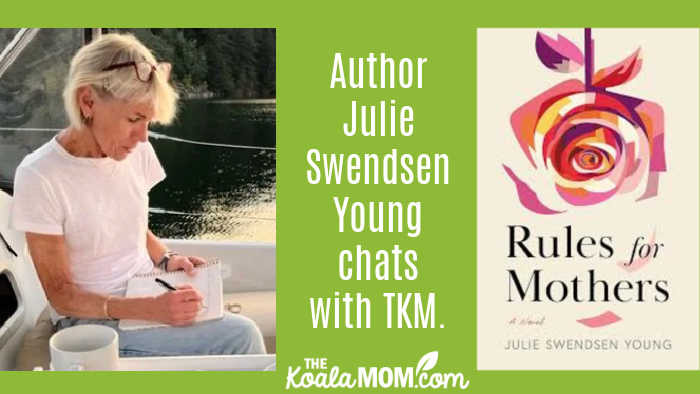
Julie Swendsen Young: Coffee shops and other public places! Unlike authors who write in a cubicle or with the door locked, I feed off the physical presence of other beings. Sidewalk cafes work really well.
TKM: Do you have another novel in the works?
Julie: I have several ideas in my head but have not sketched anything out with a beginning, middle, and end. I’m still inclined toward writing short fiction and would love to publish a collection but the short story market is challenging.
TKM: When you aren’t writing or reading, what do you enjoy doing?
Julie: I enjoy movement: hiking, fitness classes, and golf always brighten a day. But I also give a fair amount of attention to local and state politics and public policy, and get caught up in advocacy work. I get a real adrenaline rush when I wear my advocacy hat, so I guess you can say I enjoy it!
No Responses Yet