
)
)
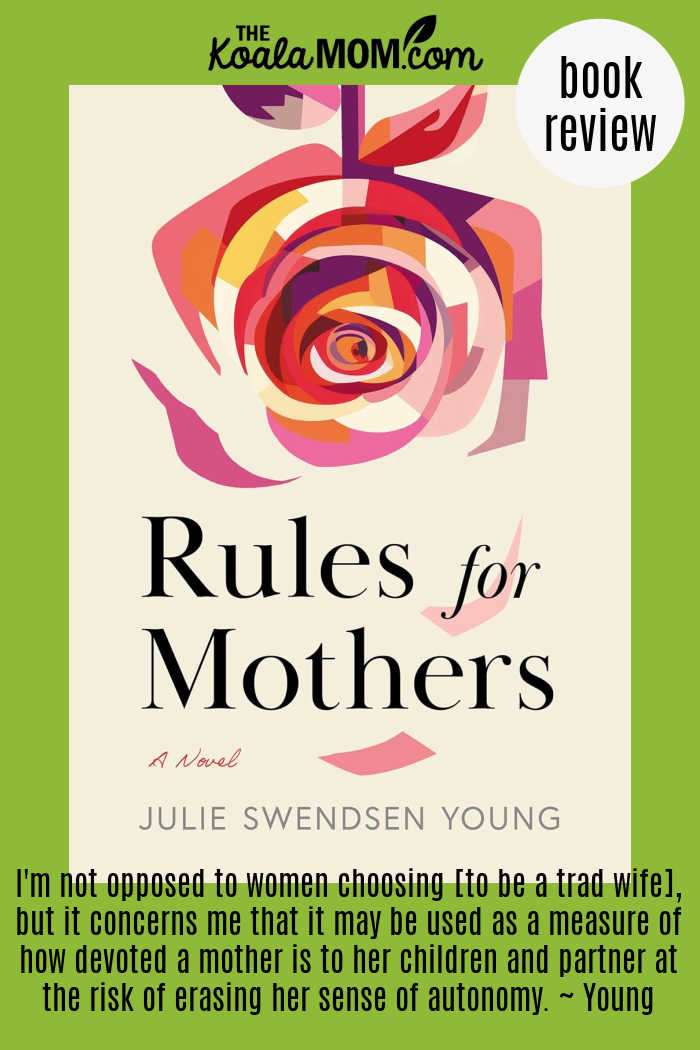
When I first saw the title Rules for Mothers, I thought it was a nonfiction book and I nearly deleted the email. I don’t need more rules as a mom. Then the book blurb caught my attention. Fiction about motherhood and mental health? Yes, that sounds like an interesting story. And it was. When I picked this slim novel, I couldn’t put it down. I binged through Elly’s story in a week and I’ve been thinking about everything Julie Swendsen Young packed into Rules for Mothers ever since.
I received this book for review courtesy of the publicist; all opinions expressed remain my own. This post contains affiliate links; as an Amazon associate, I earn from qualifying purchases.
Rules for Mothers summary
Elly Sparrow is a typical stay-at-home mom, juggling the needs of her four children and managing their busy home while her husband works long hours in his aspirations to be partner at the law firm someday. Sometimes, Elly picks up a novel just for fun and thinks about her days as an English major in university. Chance encounters with other women cause her to begin questioning her life, her own purpose.
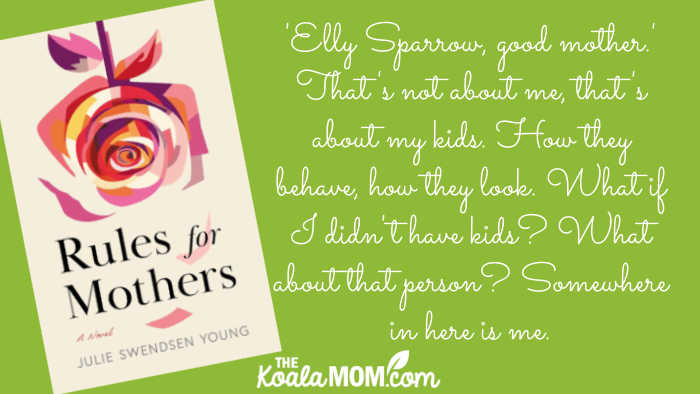
I’m a ‘good mother.’ That’s what I hear from the kids’ teachers and Nonna Luccini and the clerks at the store and the guy at the gas station and total strangers. ‘You’re such a good mother.’ That’s what they say, and I know they mean it kindly, but it’s all that anyone ever sees about me or knows about me. ‘Elly Sparrow, good mother.’ That’s not about me, that’s about my kids. How they behave, how they look. What if I didn’t have kids? What about that person? Somewhere in here is me.
When her husband moves out, Elly is left to navigate single motherhood and her questions about her life. A friend helps her get a job again. As Elly tries to balance her own needs and her kids’ needs, she begins to make a plan for her life. Then a conversation with her ex-husband sweeps that all away from her and causes her mental breakdown. In her recovery, Elly has to confront her expectations of gender, marriage, mental health, and motherhood.
All the Expectations
Early in the novel, Elly takes her children to the beach for a day (in an endless summer) and meets another family whom she describes as “hippies.” She envies their casual, relaxed attitude, how the dad is just as involved with their kids as the mom, and how they seem so happy. Bobbie shares her outlook on life:
We started noticing how people expected things of us, like ‘when are you going to have a baby?’ when we’d only been married six months. It’s ridiculous, right? We decided to free ourselves of the expectations of others as much as life would allow. For our parents, both his and mine, life is about being successful, perfect. They hide their flaws and mistakes because there’s too much at stake. Disapproval by society–bullshit society, I would add–was and is a big deal for them. I think it’s a big deal for that whole generation, don’t you? My parents faked happiness, I’m certain they did.
Many of us can identify with the weight of family and societal expectations on our lives, even if we could never throw those aside as readily as Bobbie. In many ways, Elly has drifted through life meeting the expectations of those around her, including her husband’s expectations for her, without really choosing where she wanted to go or who she wanted to be. Some of her friends make counter-cultural choices, but Elly doesn’t know herself well enough to do that. Rules for Mothers becomes her search for herself, for meaning in her life, and an examination of the expectations placed on her and whether she’s going to meet them or not.
A Picture of a Marriage
As a divorced mom who has spent several years looking at why and how my marriage failed, I found Swendsen’s portrayal of Elly’s marriage and divorce insightful. Elly and Dan and their four kids look like your typical suburban American family of stay-at-home mom and working dad. Kirkus Reviews seems to think Elly and Dan had a great relationship until they had kids and drifted apart; I think the drifting apart happened long before kids, that they never even drifted close enough to really know each other or to have a deep, lasting relationship.
Elly is done her English degree and considering a master’s degree when she meets Dan, who doesn’t know why on earth she’d want to keep studying English. Since Elly can’t justify to this idea herself (she seems to be simply following the expectations of her professors or fellow students), she can’t justify it to Dan either. While she respects how he’s worked hard to build a career, and he likes her for being smart and fun and willing to try everything, they don’t seem to have much in common:
They had fun together, she had to admit, and she thought she probably did love him. He was already her best friend. She was aware of tiny doubts but couldn’t form them into sentences, certainly couldn’t make them into a persuasive case.
And so she follows expectations and marries Dan. They have four kids in as many years and settle in the life expected of them. And yet, as the story carries on, we continue to see the cracks in their relationship. Dan treats Elly with contempt in numerous scenes, even as he expresses love for her in other scenes. He finds her boring and criticizes her for talking only about the children–whom he seems to forget are his children too, until after they are separated. Elly’s mom tells her, “Oh Elly, I worried this would happen. Four babies, Dan’s harshness, his focus on work, the two of you slipping apart even when you were living together.”
After their separation, Dan objects to Elly getting a job: “Did you ever think of asking me if it was okay if some stranger gets more hours with my kids than I do? And who is this stranger, anyway? How is it that you get to decide?” While Dan may seem to be showing concern for his kids, his response is actually controlling and dismissive of Elly’s autonomy as a parent. They are both parents who are also both people who should be able to pursue their dreams and careers, but Dan has always left all the childcare on Elly, demeaning her goals outside their family while putting endless hours into his career. This is not a relationship based on equality, trust and respect, or shared goals. This is not a relationship based on accepting and knowing each other.
Elly doesn’t have a verbal response to Dan’s question, but she has a lot of thoughts about it: “She tried to remember if they had ever discussed childcare, stay-at-home mothers versus working mothers, or Elly going back to work at some time in the future. She tried to remember if Dan had ever, even once, expressed interest in helping her find a pediatrician, a kids’ dentist, or babysitters. Did he even know the pediatrician’s name, Dr. Jensen? She thought he had accompanied her to the pediatric clinic one time when Jane was a baby, but she wasn’t sure. Dan provided for the kids financially and she did the rest. How had that happened?”
This mental weight of motherhood, unfortunately, hasn’t changed since the 1980s when Elly struggled with it. Rules for Mothers is a novel-length illustration of Psychology Today‘s observation that “mothers handle 71 percent of household mental load tasks, while fathers manage only 29 percent. This imbalance isn’t just about uneven labor division—it has far-reaching implications for stress, burnout, career advancement, and family dynamics.” In her detailed yet lyrical descriptions of Elly’s daily tasks, Swendsen shows the mental load tasks mothers face–laundry and dishes and kids’ activities and more–and just how heavy all that is.
Dan makes Elly a single mom long before he moves out on her. He isn’t involved in their kids’ lives. And while this novel is set in the 80s, when such family dynamics were fairly typical (at least in the families I grew up with), Rules for Mothers shows the problems in this gendered division of labour. Dan makes it impossible for Elly to do anything except take care of his children, but he doesn’t even admire, support, or respect her in that role. Everyone else sees that Elly is a “good mom,” but her own husband cannot acknowledge she does it well–or that she might want something more.
… after months of living apart, she had become accustomed to the separateness of their lives and was less and less curious about this man who was still her husband. A man who no longer depended on her to buy his ties or iron his shirts. She wondered occasionally if she knew him at all, had ever known him, if she would want to know him if they had just met. She could barely reconcile that without him, there would be no Jane, no Matthew, no Teddy, no Joe. It was the children, nothing else, that bound her to Dan Sparrow.
What Could Be
While Rules for Mothers is about a mom wrestling with who she is beyond “mother,” it is not negative about motherhood. Elly loves her children and loves many of the aspects of being a mom. Rules for Mothers is raw and real in its portrayal of how motherhood can cause a woman to vanish beneath its demands, but it also shows why this happened to Elly. I see myself in Elly’s story, not just in our shared experiences as English majors who considered graduate studies, moms of many children, or divorce.
I think Elly’s story of motherhood would have been different if she’d had a better sense of herself before marriage and motherhood. She is still figuring out her own life when she meets Dan and conforms herself to him and his expectations. I also did the same thing as a young woman. In Peggy, we see a woman who made a different choice, who knew who she was and was herself unapologetically. For Peggy, that means a life without children, but I think as moms, we owe it to our children to be whole, healthy, joyful mothers who know who we are and what we want.
Elly’s story of motherhood would have also been different if she’d had a supportive partner. We catch a glimpse of this in Bobbie, who seems to have a much more equal relationship with her husband. While her life isn’t perfect anymore than Elly’s is, she offers a glimpse of a marriage that isn’t constrained by gender roles. This is my current relationship, where I am supported in my dreams and goals by my husband, who actually encourages me to write or show up for the kids while he cooks or takes care of other chores. If Dan and Elly could have both chased their dreams and also both parented their kids, she may not have had either a divorce or a mental breakdown.
In an Q&A at the end of the novel, Swendsen addresses the recent tradwife trend: “Sounds like Elly! I’m not opposed to women choosing this, but it concerns me that it may be used as a measure of how devoted a mother is to her children and partner at the risk of erasing her sense of autonomy. That’s exactly the point I want to make in this book. It’s been suggested that traditions are cultural habits that can come at a cost–I tend to agree.”
Mental Health Awareness
Swendsen raises awareness of mental health not only in Elly’s story, but also in Peggy and Liz Dhillon (whose story would make a great sequel to Rules for Mothers). While our awareness of maternal mental health is better now than it was in the 1980s, there is still much work to do in this area. And one thing has not changed much for many women: we lack community as much as Elly did. Most of the mental weight of motherhood happens behind closed doors. One of the reasons I began blogging was to connect with other moms, to feel seen and heard in my struggles through shared stories.
While Elly is able to call on her mom to help in emergencies, her mom lives some distance away from her and comes to help only for emergencies. That’s my situation, and the situation of many of my friends. I do see that moms who have family help nearby find motherhood and parenting easier. While Elly bumps into Peggy, Liz and Bobbie, she doesn’t seem to have a close relationship with these women, or any women to whom she can regularly turn with questions, dreams, and struggles. She needs a mom’s group… a village… a community.
More about the Author
Julie Swendsen Young is writer, wife, grandmother, retired urban social worker, reader, and citizen lobbyist for early childhood and maternal health. Her short fiction and nonfiction has been published in various literary magazines. Rules for Mothers is her first novel. To read more about Julie or preorder her novel (available April 14, 2026), drop by her website.
Julie Swendsen Young’s Rules for Mothers is an unflinching, beautifully crafted exploration of motherhood’s contradictions: its devotion and depletion, its intimacy and isolation. Through the lens of Elly Sparrow, a mother of four whose identity unravels beneath the expectations of wifehood and maternal perfection in 1980s Oregon, Young crafts a deeply human portrait of quiet suffocation and self-awakening. ~ San Fransisco Book Review
No Responses Yet