


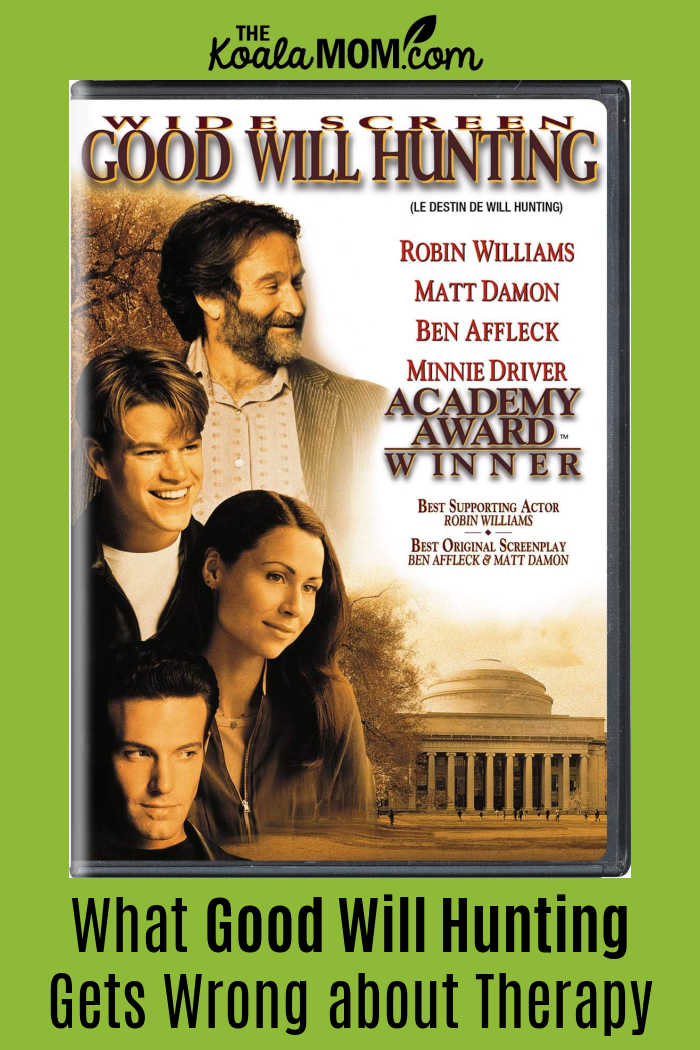
Good Will Hunting (1997) is one of Hollywood’s best depictions of therapy and its benefits. Matt Damon plays a young genius who is held back from his full potential by his childhood abuse; Robin Williams plays the therapist who helps him find healing from those wounds. Written by Matt Damon and Ben Affleck, this movie is a brilliant look at the effects of abuse and how therapy can help a person move forward. However, Good Will Hunting gets one important thing wrong about therapy.
This post contains affiliate links; as an Amazon associate, I earn from qualifying purchases.
How to Find a Therapist
Professor Lambeau (played by Stellan Skarsgard) gets Will Hunting (Matt Damon) out of jail on the agreement that Will goes to therapy, so Lambeau begins to rope in colleagues to help Will. This seems like a rather hit and miss process, as therapist after therapist refuses to help Will, until Lambeau reaches out to Sean Maguire (Robin Williams) in a last-ditch effort. Unlike the other therapists, Sean is willing to put up with Will’s belligerence and work with him. This illustrates a few points about finding a therapist.
First, Lambeau doesn’t seem to know much of Will’s background when he begins searching for a therapist. Instead of asking his psychologist / college friends for a favor, he should be searching for someone who has experience in child abuse and foster care-related trauma. Someone who also has experience in working with gifted individuals would be great too. Asking for referrals from one’s friends can be a good way to start a search for a therapist, but if your friend’s friend who is a therapist doesn’t have any experience in your area of trauma, then they won’t be very helpful. (Side note: your friend who is a therapist can help you find a therapist, but they cannot be your therapist.)
Second, the therapist’s personality matters as much as their experience. This can make a search for a therapist look a lot like it does in Good Will Hunting. Let’s assume Lambeau did actually check his colleague’s credentials and their areas of specialization all met Will’s needs. A perfect fit between a client’s trauma and a therapist’s experience doesn’t always mean a perfect fit between client and therapist. Because therapy is so personal, there are more subtle nuances at play, such as the personality of each person and how well they “click” together. For various reasons, the first few therapists are unable (or unwilling) to connect with Will, but Sean does.
Will’s interaction with various clinicians highlights the importance of the therapeutic match, that there is no one-size-fits-all approach to mental health. Similar to any other relationship, therapy is centered on interpersonal alignment and works best when the person feels connected to the clinician. ~ Psychology Today
 Licensed therapist Jonathan Decker from Cinema Therapy explains that Sean’s unorthodox methods work because “it’s the relationship that heals… I can master all the techniques, I can master all the styles, I can stay immersed in the research and current with the research and if I can’t connect with people, I’m not gonna be a great therapist.” All the techniques are less important than the relationship that develops between the therapist and the client. Sometimes, shared experiences between the therapist and the client (such as Sean shares with Will) can build this relationship. Other times, the relationship is a match of personalities or other (less tangible) factors.
Finding the right therapist may require a willingness to try a few therapists before deciding one is helpful to you. If your first therapist doesn’t immediately help or click with you, please try another therapist (or two or three) before assuming that therapy doesn’t work.
This is one reason we come to therapy, is people think “I don’t need therapy” or “I don’t need counseling.” Well, you’re boxing yourself in and you don’t see that you’re doing it. You’re creating traps in your mind that are limiting yourself through incorrect beliefs or limiting beliefs and you need someone skilled and trained to help you see it. And it’s not pleasant. ~ Cinema Therapy
Lambeau’s clumsy efforts to connect Will with a good therapist do illustrate the problems in finding a therapist for those searching for healing. The proliferation of online counseling has opened up more opportunities for finding therapists; however, not all of these therapists are equally qualified or experienced. It can be hard to admit we need help, and even harder to search for a person who can help us, but it’s important to invest some effort in this search. Take the time to check the therapist’s qualifications and background, ask for referrals, and even use the first session together as an “interview” of the therapist.
Therapy is a Journey
Sean works with Will over eight (or more sessions), during which Will consistently refuses to open up to Sean or participate in therapy. Will’s resistance to therapy clearly shows that without the client’s buy-in, therapy will fail. Sean cannot help Will unless Will wants to help himself. In Good Will Hunting, we expect that Sean will somehow (miraculously) overcome Will’s unwillingness to be helped. The truth in real life is that a person who is going to therapy simply because they’ve been told by a judge, mentor, spouse, or parent to do so will likely not benefit much from therapy.
Will’s breakthrough moment in therapy is obviously the film’s climax and has also reappeared recently in social media memes and reels (which brought the film to my attention). Clinical psychologist Joseph Jones, in his critique of Sean’s therapeutic methods in Good Will Hunting, explains why this moment matters so much:
The repeated phrase, “It’s not your fault,” becomes the pivotal intervention. While its precise origin in Sean’s mind is unclear, it seems intuitively chosen and deeply relevant to Will’s core trauma and their evolving relationship. It was a risky intervention, cutting through layers of defense, but it worked profoundly. Will is finally able to express blocked emotions and allow himself to be vulnerable, which is an incredibly valuable and healing experience.
Will then goes on to his happy ending: “he pursues a meaningful job, begins to form a secure attachment, opens up to another person, and even expresses gratitude. The pain he shows when he has to ‘let go’ of Sean signifies the depth of the connection but also his growth in being able to navigate such emotions” (Jones). He literally drives off into the sunset (okay, down a long highway while the credits run) and is presumed to live happily ever afterward in California with his girlfriend Skylar (played by Minnie Driver).
Except… that’s not how trauma and therapy work. Therapy is a journey that requires a lot of hard, personal work, which Will never does. While there may be breakthrough moments in therapy, such as the “not your fault moment,” these moments are not the end of therapy but rather the beginning. This was the moment when Will actually opened up, became willing to look at his past and acknowledge the pain, and began to do the work required to become a healthy, whole individual who can freely love another person. If his therapy ends here, I guarantee he will get to California and keep pushing Skylar away, keep failing to hold a job, keep repeating his old, trauma-informed habits.
Trauma is such a cunning enemy. Those of us who’ve survived its terror often marvel at how quickly it can recede, at least at first. Once you get to safety, your visible wounds – your cuts, your bruises – heal and fade. Your psyche too revives, like a drowning man, who, pulled from the depths, somehow spits up dark water and opens his eyes. But recovering victims like me know too well how trauma lurks in the shadows, always there. No matter how many years go by or how many therapists you see, it can rise, unbidden, seemingly out of nowhere. A song on the radio may summon it. Or the scent of a stranger’s cologne. For you, the trigger probably won’t be a wall-sized tapestry in the Louvre, but you never know. ~ Nobody’s Girl by Virginia Roberts Giuffre
As a society, we love quick fixes. We want 3-step parenting plans, guaranteed techniques to solve marriage conflicts, one thing that will make us lose weight overnight. We don’t like putting in the work to rebuild relationships or lose weight or otherwise improve our lives. The truth, however, is that nothing will improve if we don’t put in this work. Until Will can acknowledge his past trauma and how it continues to affect his everyday life, he is going to keep using the same coping skills based in that trauma (and so will we if we make the same mistakes as Will).
Will also demonstrates the fact that a person can read all the books about therapy and spout off all the right information without ever applying that to his own life and doing any of the hard work of healing. Self-help books abound and can sometimes be useful in our journeys towards healing and wholeness, but often, we need the input of an neutral, trained, and experienced person to help us see our own wounds and problems and find ways to move towards healing.
Good Will Hunting overview
Like the Cinema Therapy guys, I thought this movie did an overall great job of raising awareness about abuse and therapy. I agree with them that the screenplay was brilliant, even though the excess swearing and bathroom humor (which got it an R rating) show that it was written by two guys in their mid-twenties. Damon and Affleck could have cut out some of the scenes of stupidity and put more effort into either Will’s backstory or to the work he did on healing after his breakthrough. I don’t recommend watching this with teens, honestly, and was glad that mine opted to study when I decided on a whim to watch Good Will Hunting.
Parents need to know that despite a constant onslaught of angry, sexual, and insulting language … in Good Will Hunting, mature teens and adults will find this Oscar-winning drama about a self-destructive young man who’s transformed by caring relationships to be an uplifting and inspiring story. ~ Common Sense Media (rating: 15+)
What do you think of Good Will Hunting, therapy, or the actors who tell this story?
No Responses Yet