


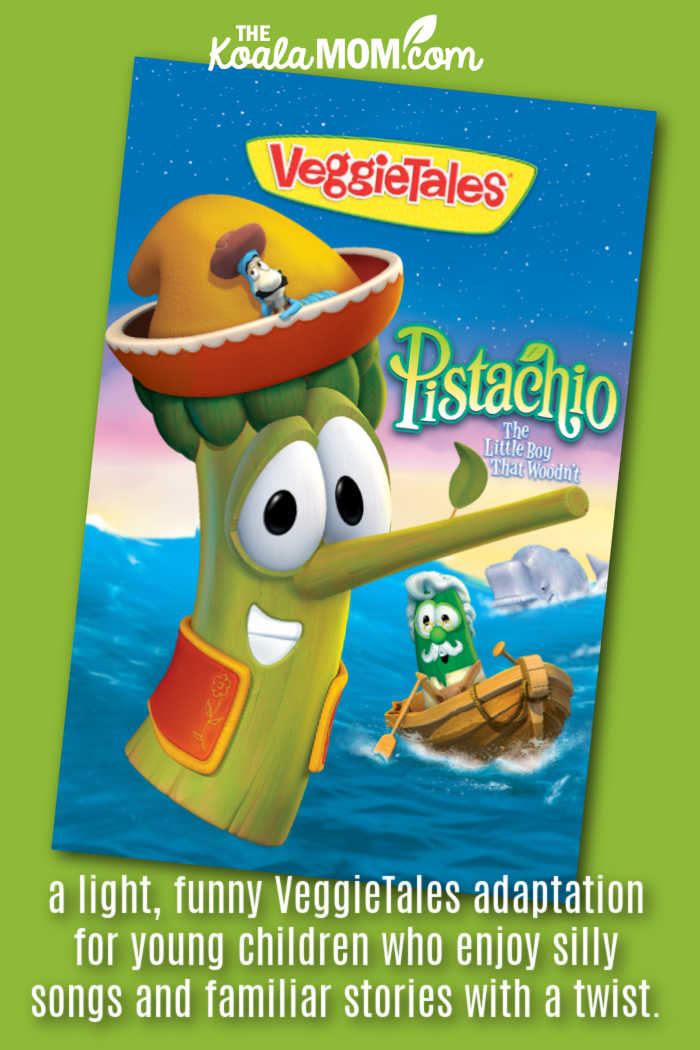
Years ago, Sunshine and I spent a morning doing laundry and watching Pistachio: The Little Boy that Woodn’t. I requested the movie for review because I thought she was finally old enough to enjoy VeggieTales. I’d spent hours watching older VeggieTales stories with the kids I babysat, bopping along to the Silly Songs while doing my own homework.
Sunshine sat through most of it and, when I asked whether she liked it, she gave me a simple, “Yeah.” She wasn’t quite as excited about the music and Silly Songs as I expected, but I enjoyed the movie and appreciated the way it put a familiar story into a distinctly VeggieTales setting.
This post was originally published as a review copy provided by David C Cook and Graf-Martin Communications, Inc. My opinions remain my own. This post may contain affiliate links, which means I may earn a commission from qualifying purchases.
Pistachio Summary
Pistachio: The Little Boy that Woodn’t is VeggieTales’ take on the classic story of Pinocchio.
Gelato is a lonely toymaker who receives an unusual piece of wood and carves it into a toy boy named Pistachio. Much to Gelato’s surprise, Pistachio comes to life—but instead of being grateful, Pistachio immediately declares that he wants to do whatever he wants and doesn’t intend to listen to his dad.
Gelato and his adopted ducklings try to teach Pistachio some important lessons, but Pistachio is easily distracted. He gets caught up with a puppeteer and eventually falls in with two street-wise vegetables who lead him further astray.
Eventually, Pistachio realizes that he should have listened to Gelato in the first place. He has to figure out how to get back home and learn some lessons about trusting his dad—even when he doesn’t understand why his dad is telling him to do something.
It’s been a long time since I read the original Pinocchio, so I enjoyed seeing how VeggieTales adapted the familiar story. There are plenty of the usual VeggieTales surprises and twists along the way.
My Thoughts on Pistachio
Most of Pistachio is upbeat and fun, although there is one storm scene near the middle of the movie that could be frightening for some younger children. It didn’t bother Sunshine when we watched it, but it’s something parents of sensitive kids may want to know about. Common Sense Media recommends the movie for kids ages four and up, and I’d agree with that rating.
And, of course, there are the songs. One of my favourite parts was the Silly Song in the middle of the movie. Larry the Cucumber and another vegetable perform an “Obscure Broadway Hit,” and it was exactly the sort of silly musical interlude I’ve come to expect from VeggieTales. The office humour—and even the tune of “Where Have All the Staplers Gone”—will probably go over kids’ heads, but parents can appreciate it.
The main lesson of Pistachio is fairly straightforward: listen to your parents, because they often know things you don’t. Pistachio wants the freedom to make his own choices, but his adventures help him realize that Gelato’s rules aren’t simply about keeping him from having fun. His dad is trying to protect him and teach him.
That makes Pistachio a fun way to introduce younger kids to the basic themes of Pinocchio while giving the story the humour, music, and vegetable characters that make VeggieTales distinctive.
Looking back on this movie years after our original viewing, I’d still recommend it as a light, funny VeggieTales adaptation for young children who enjoy silly songs and familiar stories with a twist. And apparently, VeggieTales stuck with my kids. My teens now appreciate it almost as much as I did, and it’s not unusual for one of them to randomly break into one of the songs.
VeggieTales fans may also want to check out their favourite vegetables’ antics in the I Can Read! series. In The Mess Detectives and the Case of the Lost Temper, Bob and Larry try to figure out who is slamming doors.
If your kids liked this movie, they may also like:
No Responses Yet