
)
)
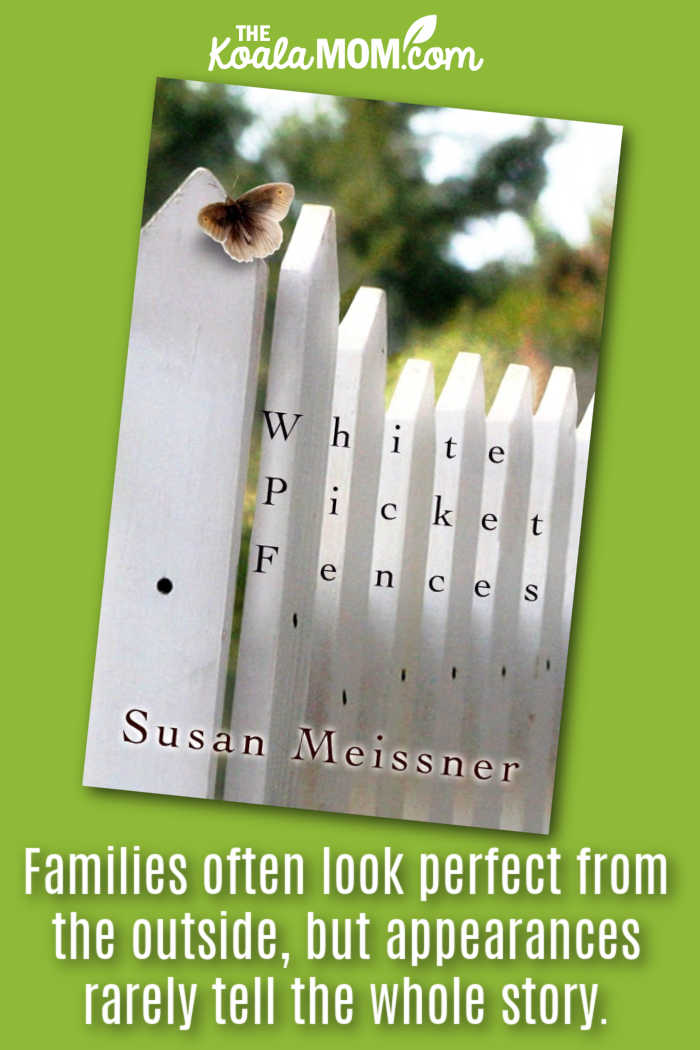
Families often look perfect from the outside, but appearances rarely tell the whole story. In White Picket Fences, Susan Meissner explores what happens when carefully constructed images begin to crack, revealing long-buried secrets, painful memories, and unexpected grace. It’s a thoughtful novel that asks readers to reconsider what really makes a good family.
This book was provided for review by the WaterBrook Multnomah Publishing Group; all opinions expressed remain my own. This post contains affiliate links; as an Amazon associate, I earn from qualifying purchases.
White Picket Fences overview
Amanda Janvier has the perfect life. Nice house, nice job, good husband, two kids. Not like her brother Bart, who can’t keep a steady job or even a steady home for his daughter Tally. Now, Tally is coming to live with Amanda and her family because Bart is off in Europe on a wild-goose chase. But as Tally settles into their family, Amanda slowly discovers her life isn’t as perfect as it seems.
Amanda’s son Chase connects with Tally on the night that she arrives, sensing a kindred spirit because they both share secrets. To Tally alone does Chase confide his struggles to remember a childhood trauma. Amanda senses her son’s struggles, but is unable to connect with either him or with her husband—and feels like her family is falling apart.
As Amanda’s carefully ordered life begins to unravel, she is forced to question assumptions she has held about success, parenting, forgiveness, and even her own marriage. At the same time, Chase and Tally’s school project introduces them to Holocaust survivors whose experiences with loss, family, and resilience subtly mirror the struggles unfolding in Amanda’s own home.
My thoughts on White Picket Fences
What impressed me most about White Picket Fences wasn’t simply the family drama but the compassion Meissner shows toward each character. It would have been easy to paint Amanda as shallow or Bart as irresponsible, yet neither is portrayed as a stereotype. Instead, Meissner allows readers to see each person’s fears, failures, and motivations. As the story unfolds, it’s clear that every family carries burdens invisible to outsiders.
This novel also explores childhood trauma with sensitivity. Chase’s fragmented memories become one of the emotional threads that keeps readers turning pages, and Meissner handles his story with empathy rather than sensationalism.
Reading White Picket Fences today, I thought of how easy it is to compare our own messy lives to other people’s carefully curated images on social media. Whether it’s a perfectly kept home, a successful career, or smiling family photos online, outward appearances can hide struggles that few people ever see. White Picket Fences reminds us to be slow to judge and quick to extend grace because every family has a story beneath the surface.
In an interview at the end of the book, Susan says she was led to write White Picket Fences because she “saw that despite the outward appearance of a less-than-perfect home, a child could be loved there. Just because a parent is unconventional or unsuccessful career-wise or makes choices that buck society norms, it doesn’t mean that he or she is by default a ‘bad’ parent. Likewise, parents who we would traditionally call ‘good’ . . . can nevertheless make decisions regarding their children that have hugely negative effects, and yet their outward appearance would never lead anyone to suspect it.” This story delves into those outward appearances and the judgements we make on such families.
Who Should Read White Picket Fences?
Readers who enjoy thoughtful women’s fiction centered on family relationships will appreciate White Picket Fences. It’s an excellent choice for fans of Susan Meissner’s later novels, as well as readers who enjoy authors like Kristin Hannah, Lisa Wingate, or Diane Chamberlain. The novel also raises thoughtful questions that would make it a great pick for a book club.
More about Susan Meissner
Susan Meissner is an award-winning author of historical and contemporary women’s fiction. Her novels include The Nature of Fragile Things, The Last Year of the War, Secrets of a Charmed Life, and As Bright as Heaven. Known for weaving together family relationships, historical events, and themes of grace and redemption, she has become one of today’s most respected voices in Christian and mainstream women’s fiction.
For those interested in discussing this book in a book club, Susan has a list of questions available on her website. You can also find an excerpt from the book and more information on the Random House website.
No Responses Yet