


Sometimes the most fascinating historical sites aren’t the famous landmarks we plan years in advance to visit. Sometimes they’re the quiet places we drive past, hike through, or visit without realizing the stories hidden there. As I’ve researched David Thompson’s wife Charlotte Small, I’ve been surprised to find out I’m familiar with many of the places they traveled and worked.
Some of these places are obvious, such as Rocky Mountain House and Peace River. Others were more surprising, such as reading On the Road with David Thompson and finding out that, instead of going straight west from Rocky Mountain House in his first attempt to cross the Rockies, he went south, roughly along what is today Highway 22—a road I’ve frequently traveled.
The Thompsons at Fort George
Another surprise was finding out that the Thompsons spent their first winter together at Fort George. Last summer, we stopped by several historical sites in Alberta and Saskatchewan while visiting friends. One of those was Fort George and Buckingham House, Northwest Company and Hudson’s Bay Company posts built within four hundred metres of each other.
However, the forts burned down shortly after they were abandoned in 1800, so there are now only holes in the ground there. We only toured the museum, deciding not to make the hike out to see the actual forts. Learning that Charlotte was there, however, made me want to go back there to look around again. My husband teased me about looking at holes in the ground. When he had an interview in the area, I had my chance to go exploring again.
Walking Where Charlotte Walked
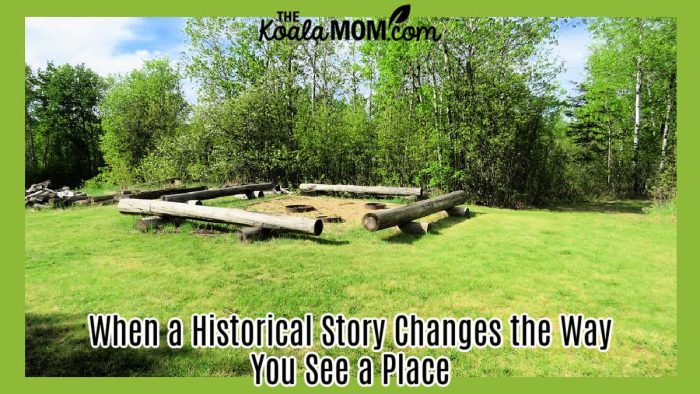
A bored guide was happy to take my toddler and I on the walk to what’s left of Fort George and Buckingham House. There was, indeed, little left there, though frames and posts show the rough outlines of where the fort used to be. During the 1960s-80s, there was quite a lot of archaeological work done there, but now grass has grown over the holes.
Our guide left us when I decided to hike the steep trail down the river. I was a bit surprised that the forts had been built on a bluff so high above the river. I guessed correctly that this was because of flooding. The guide explained the river often changed course and the forts needed to be built where the water couldn’t affect them.
Still, as I huffed my way back up the trail, imagining voyageurs doing the same but carrying 90-pound packs of furs or trade goods instead of a 20-pound baby, and making the trip more times than I could count, I wondered that they couldn’t have found a better spot for the fort.
Lessons from History
What did I learn from the trip? Well, Fort George had been in a state of disrepair when David and Charlotte showed up. David mentions having to rebuild several buildings to prepare for winter. After they left, the fort closed for good; David’s winter there was probably a last attempt by the NWC to make some profit from that area.
It was also interesting to actually walk the distance between Fort George and Buckingham House and from the fort down to the river, to get an idea of what that would have been like for David and Charlotte and the rest of the fur traders. And now I can describe Fort George’s location, down to the saskatoon bushes growing everywhere that surely provided plenty of occupation for Charlotte.
Planning Your Visit to Fort George and Buckingham House
Whether you come with a passion for history or with a desire to make great family memories, you will be intrigued by the stories of these fur trade forts during 1792. Take a guided walk on a winding trail through the aspen forest. Stand where the forts once stood and where history actually happened.
This isn’t the kind of historical site where children will see reconstructed buildings and costumed interpreters everywhere. Instead, it’s a place where kids can use their imagination: “Where would the fort walls have been?” “Where would people have cooked?” “How would you have gotten water from the river?”
Fort George and Buckingham House is a seasonal historic site, so check the Alberta Parks website before visiting for current hours, admission fees, and special events.
If you’re interested in the Canadian fur trade, you may also enjoy visiting Rocky Mountain House National Historic Site.
No Responses Yet