


Getting children to Mass is often a struggle for Catholic moms. Add neurodivergence to the other reasons kids have for not wanting to attend Mass, and Sundays can become the most dreaded day of the week. This hour which should be calm and worshipful becomes a source of stress, impatience and anger for the whole family. If this sounds like you, please know that you are not alone. From other moms who’ve been there done that, here are a few tips.
Of all the struggles I hear about from moms of sensory kids, Mass attendance is at the top of the list. The organ is loud. The incense is heavy. The pews are uncomfortable or the kneelers hard. Many Catholic moms of sensory kids live in the in-between, desperate to find ways to make Mass more comfortable for their children while silently questioning whether their standards should be higher. Mass becomes a battle on physical and emotional fronts. ~ Ginny Kochis of Quirky Catholic Kids
This post contains affiliate links; as an Amazon associate, I earn from qualifying purchases.
Talk to Your Child
Start by trying to choose an ideal time to talk to your child about why Mass is hard. This should be a time when your child is calm and regulated, and you can approach with curiosity, involving them in finding solutions for their discomfort at Mass. Listen first, rather than proposing your ideas for solutions. Ask your child what they dislike about Mass, or what is hard, and what might help them to at least sit through Mass. If they shut down, let them know that you’d like to hear their perspective if they are willing to share another time, and move on.
This approach to your child’s struggles at Mass is based on Ross Greene’s collaborative and proactive solutions (CPS) model for addressing challenging behavior. It focuses on identifying the skills your child is lacking and the expectations he is having difficulty meeting. For example, attending Mass comes with numerous little expectations, from what your child wears to how they sit to whom they talk to. Perhaps they lack skills to get ready for Mass or perhaps they have sensory issues that make Mass itself a huge pain (literally) to them. Acting like your child’s team mate, try to explore all these things together and to see Mass from your child’s point of view.
Try Attending Other Masses
If you live in a very rural area, this option might be difficult. However, thanks to our post-covid world, there are now numerous online Masses. If you cannot make it to Mass in person, consider finding a favourite online Mass. When one of my kids is sick or unable to attend Mass, we’ll look up Mass with Father Mike Schmitz. Perhaps your local parish streams their Masses or you can find another parish that your family enjoys attending virtually.
If you live in an area with numerous parishes or numerous Mass times, try another Mass. For example, the Sunday morning Masses at our parish are packed. We sit shoulder to shoulder in every pew, meaning that my wiggly 7-year-old is more likely to kick or elbow his sisters or the people around us. If we attend an evening Mass, then we often have more space, and he’ll sprawl across the pew, sketching quietly while the rest of us participate in Mass. When I can, I draw him into what’s happening at the front of the church, which is easier without a wall of shoulders and heads in front of us, blocking the view.
If your child has sensory issues with the noise or smells at Mass, sitting in another area of the church or attending another Mass may help alleviate these issues. Different parishes have different styles of music or slight differences in the liturgy. There may be different seats or quieter areas of the church where your noise-sensitive child can enjoy the Mass without being overwhelmed by all the sensory input. If your child cannot identify what specifically makes Mass more difficult, then it may take some trial and error in this way to figure out what works for your family.
Some kids enjoy sitting in the very front pew, where they can easily see what’s happening during the Mass. This worked for a Good Friday service when my son was 5. I had dreaded the 2.5-hour service because he could barely get through a regular 1-hour Mass, but he sat either with me or one of his older sisters for the entire Mass and watched the priest and the people coming up to venerate the cross and receive communion. He whispered questions to me and I whispered answers back and we made it through the entire service, thanks to that front-row seat.
For other kids, the back of the church, a corner, or the cry room may be more comfortable. These spaces may be more quiet or offer more space for them to wiggle. Look around your church and consider where your child would be more comfortable or what would help them.
Give Yourself (and Your Child) Grace
Many of us who are neurodiverse think in black and white, right and wrong. Obligatory Mass days weigh heavily on us; we must go or we are sinners bound for hell. As a parent of neurospicy kids, I’ve had to let go of this idea. God values relationship more than rules and enforcing those legalistic rules may do more damage to the relationship than finding creative solutions to my child’s struggles.
Another mom shared, “We decided to stop forcing this issue. Clearly, it was a mental health issue, which made our child exempt, as well as the adult who stays home to care for them. You don’t need your priest or spiritual director’s permission to make this decision; you are the parent who knows your child and their needs best. After letting go of the demand to force a child to attend, usually they do choose or ask to go (maybe not the same week or day, but eventually).”
It’s important to note that Mass is not meant to cause suffering for your entire household. Mass is a chance to meet with God and grow in our relationship with him. However, if we show up grumpy and stressed and angry at our kids, and our kids show up the same way, we aren’t really cultivating relationship. I want my kids to desire a relationship with a loving, merciful God who sees them for who they are in all their unique neurospiciness, rather than how well they follow the rules.
Offer Autonomous Choices
If your child likes making choices for herself, involve her in choices regarding Mass. Let her choose what to wear to Mass (which may mean letting go of your expectations around how your family looks in church). Kochis notes that her oldest “feels much more secure in Mass if she’s wearing a coat or a cardigan sweater. She likes to be able to pull it tight around herself. Some children benefit from weighted vests or even weighted blankets. Small weighted blankets can be draped around the shoulders and worn like a shawl.”
Discuss which Mass to attend. For example, one Sunday my son loudly declared that he didn’t want to go to Mass. I made it clear that we were attending Mass because this was important to us, but I listed several options for when and where we went to Mass. He ended up choosing a morning Mass at our usual parish, but just having the discussion seemed to help him.
Bring Fidgets
There are now numerous Catholic artists who are offering quiet Mass activities to help keep children engaged during Mass. This may again take some trial and error to see what engages your child and lets them be present at Mass without being fully distracted or dysregulated. Many of these fidgets are more suited to younger children, so it can be harder to find options for older children.
Younger kids may find these fidgets and books helpful:
- sticker by number books
- rosaries, pop-its and fidget jewelry
- Symbols of Faith I Spy bags
- Catholic water reveal cards
- faith-based magnetic play scenes
- saintly reusable sticker books
- children’s Mass activity book
- Mass book for kids
- North American Martyrs Kids Activity Pocketbook
Older kids may benefit from:
- a children’s missal, to allow kids who can read to follow along with the Mass parts and readings. Add a pen or highlighter so they can take notes or doodle in the margins during Mass.
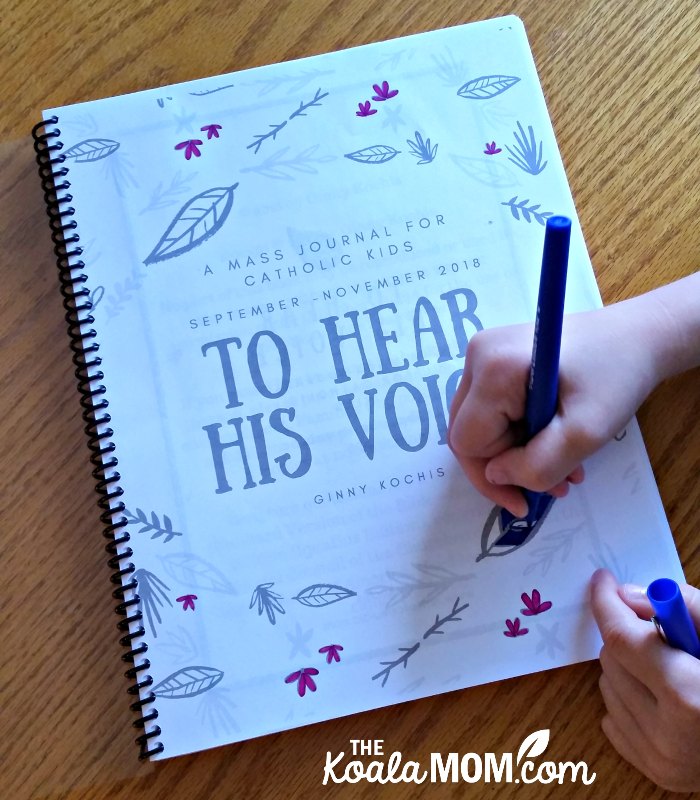
- To Hear His Voice: A Mass Journal for Catholic Kids by Ginny Kochis
Live the Liturgical Year at Home
Mass should not be the only time that our children encounter God, but simply a regular part of our life in faith. Before you click away, please know that I am not saying you need to celebrate every single feast day and have a giant liturgical calendar on your wall. I have gone through seasons of life when I’ve been as liturgical as Maria von Trapp and other seasons of life where we’re lucky to remember to say grace before lunch. Once again, I’ve learned to give myself grace for whatever way I am able to show up in my relationship with God and my relationship with my children.
Living the liturgical year at home doesn’t need to be something huge. We have conversations everyday around praying for people close to us. We bring up saints and Bible stories in everyday conversations. Some special times of the year, like Easter and Christmas, offer more opportunities to discuss the faith, while ordinary time is a time of faith in the ordinary. Sometimes that’s just grace before meals, or Bible stories for bedtime, or a rosary when we hear an ambulance siren.
Think of this, again, as cultivating a relationship rather than following rules. While I do have friends with whom I talk only an hour (or less) a week, those are not my closest friends. God wants to be one of our closest friends. How can we have little conversations with him throughout the week, so that setting aside one hour in the week feels like a date rather than a duty? How can I show my kids these little prayers, these little gestures towards God, that I make throughout the week, which culminate in having more time to talk to him at Mass?
Become an Advocate
Before my son’s ADHD diagnosis, I knew nothing about neurodivergence and sensory needs. Sure, I’d heard terms like ADHD and autism and OCD, but I didn’t really know how those affected individual people or how our society is designed for neurotypical people and can be difficult for those with other needs. As I’ve learned more about my kids’ needs, I’ve also come to recognize the ways in which I’ve suppressed my own needs. Now, I’m much more gentle with myself and my kids about what makes us both uncomfortable and comfortable.
Sometimes, our family’s need is the opportunity to become an advocate for other families who are facing the same struggles. When I began to open up about my son’s ADHD, I discovered many other moms around me had neurodiverse kids too. I know how lonely it can be to feel that nobody around you knows what you are going through. I know how it feels to be judged by other people at church for what your child is doing or going through. And I also know how empowering and inspiring it is to connect with other families who are willing to listen and to share their own experiences with you.
Some parishes, like St. John Vianney, are now offering sensory-friendly Masses. This “shorter Mass featured dimmed lighting, soft music and no bells. Parishioners were encouraged to sit, stand, move and participate in the Mass as needed.” Such a Mass begins only because some families began to express their needs. If there are small changes your parish could make to better accommodate neurospicy kids and their families, consider becoming an advocate, not just for your family, but for any other family attending Mass who may be feeling alone and isolated.
Amanda Wallace is St. John Vianney’s media specialist and assistant faith formation coordinator and the mom of a son who has autism. She said, “Our experience with autism has been a lonely one. When seeking sacraments when Max was younger, we were told we could handle it. The path was a challenge. There was no support from the church, and that really was because they had no idea how to provide that support.” Sometimes, parishes are willing to offer the support if they know what supports are necessary, and all it takes is someone asking.
What tips would you share for helping neurodivergent children and families enjoy Mass?
No Responses Yet